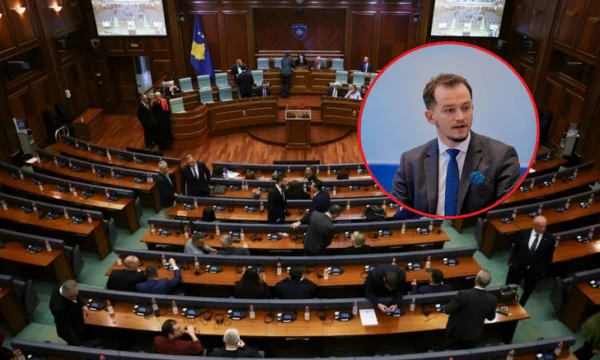
Eugen Cakolli of the Kosovo Democratic Institute (KDI) has explained the parliamentary procedures that must be followed after the decision by the PDK and LVV to proceed with a new draft law on the Specialist Chambers, which will be based on the text of the law approved by the Assembly of Kosovo in October this year.
In a response to Gazeta Express, Cakolli said that the Law on the Specialist Chambers, approved on October 6 and returned for reconsideration by President Justina Shiroka-Pula, still needs to reach a procedural conclusion in the Assembly.
According to him, the Rules of Procedure of the Assembly set a four-week deadline for the responsible committee to prepare its report. Since the President’s decision was forwarded to the Assembly on October 26, this deadline expires on Monday, November 23.
Cakolli stressed that the law is considered unapproved if the Assembly fails to overturn President Shiroka-Pula’s veto with at least 61 votes.
“As regards the Law on the Specialist Chambers, approved on October 6 and returned for reconsideration by the President, the Rules of Procedure of the Assembly set a four-week deadline for the responsible committee to prepare its report. Given that the President’s decision was forwarded to the Assembly on October 26, this deadline expires on Monday, November 23. The law is considered unapproved if the Assembly fails to overturn the President’s veto with at least 61 votes. If the parties have decided no longer to support the current text, this matter must reach a procedural conclusion in the Assembly,” Cakolli told Express.
Regarding the possibility of proceeding with a new draft law on the Specialist Court, Cakolli explained that this would constitute an entirely new legislative initiative, regardless of any similarities it may have to the previous text.
This means that the new draft law would start the procedures from scratch and be subject to all the deadlines set out in the Rules of Procedure of the Assembly.If the initiative is proposed by MPs, it must be supported by at least six MPs and first be sent to the Government for an opinion. The Government has up to 30 days to respond.
After the Government’s opinion is received, or the response deadline expires, the parliamentary procedure begins. The first reading cannot be held until two weeks have passed since the draft law was distributed to MPs. Meanwhile, after approval in principle, 15 days are provided for submitting amendments, consideration by the responsible committee, and up to a further 15 days for consideration by the standing committees, before the vote in the second reading.
According to Cakolli, under the ordinary procedure, approval of such a draft law could take around two to three months from the time it is submitted.Thus, if the new initiative is submitted next week, in the optimal and realistic scenario, it could become law only at the end of this year or at the beginning of next year.
However, Cakolli said that the deadlines could be shortened if the Government provides its opinion sooner and the Assembly uses procedural mechanisms to expedite consideration.
The Rules of Procedure of the Assembly provide that, at the request of the Government or at least 30 MPs, draft laws relating to national security, public health, or budgetary and financial matters may be considered under an expedited procedure.
However, Cakolli warned that applying this procedure to amendments to the Law on the Specialist Chambers would require a specific justification showing that the conditions set out in the Rules of Procedure of the Assembly have been met.
He also stressed that the Assembly may decide to depart from procedural deadlines with a two-thirds majority of MPs present, but this possibility is not unlimited and must not undermine the constitutional requirements for a proper legislative process.
“In this case, the first reading may be held 48 hours after the draft law is distributed, while the second reading may be held at least 72 hours after approval in principle. Thus, theoretically, the parliamentary procedure may be completed within five days of the draft law’s distribution, provided the Government’s opinion has also been obtained beforehand. However, for amendments to the Law on the Specialist Chambers, applying this procedure would require a specific justification regarding compliance with the conditions set out in the Rules of Procedure. The Assembly may also decide to depart from procedural deadlines by a two-thirds majority of MPs present, but this possibility is not unlimited and must not undermine the constitutional requirements for a proper legislative process,” he said.
Acting PDK chairwoman Vlora Çitaku said today at a press conference that the Law on the Specialist Court would return to the Assembly, that they had agreed on this with LVV leader Albin Kurti, and that they had received the Government of Kosovo’s commitment to support it.
“The draft law will be based on the text approved in the two readings in the Assembly. We will make the necessary changes to that text to make the law more legally robust and provide concrete state support to the liberators. Mr. Kurti and I have agreed on the content of the law and the changes that need to be made. The differences were over the parliamentary procedure. Then we agreed on the legal path they will follow,” Çitaku said today.
The new law on the Specialist Court was initiated by the PDK following the Hague conviction of the four KLA members. Its approval in the Assembly took place after an agreement with the LVV on the presidential vote.