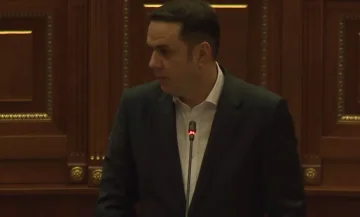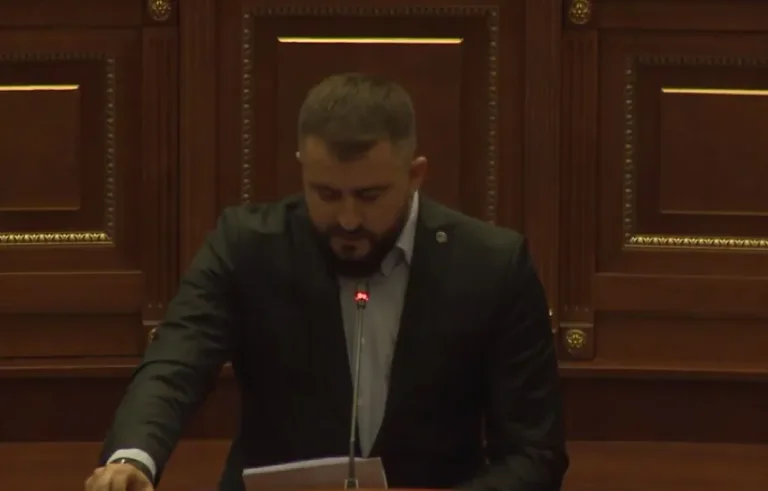
Kosovo Democratic Party MP Mergim Lushtaku has criticized the draft budget for 2027, saying that the increase in the state budget is not reflected in improvements to citizens’ well-being.
During his speech in the Assembly, Lushtaku said that, despite the increase in the budget, citizens continue to face inadequate salaries, high food prices and expensive electricity bills.
“Today we have before us the draft budget for 2027, amounting to around 4 billion 270 million euros. The government presents this figure as proof of economic success, but the question is whether citizens’ well-being is increasing as much as the state budget, because citizens do not live on billions on paper, but on their salaries, pensions, food prices and high electricity bills,” Lushtaku said.
Addressing Prime Minister Albin Kurti, Lushtaku called for accountability for promises made over the years, citing the construction of 160 kindergartens, 4,000 apartments for young families, the modernization of railways and the completion of infrastructure projects.
He stressed that, after several years in government, citizens expect concrete results, not repeated promises.
“Today is not the time to ask for trust in your promises. Today is the time to account for the results that the people of this country have not received,” Lushtaku said.
Referring to data from the GAP Institute, he said that between 2021 and 2024, completed capital investments were around one billion euros lower than the government’s plans.
He cited the Pristina Ring Road as an example, a project worth 61 million euros for which only one million euros has been earmarked in the 2027 plan, as well as the Dukagjin Road, worth 31 million euros, for which the same amount has been planned.
According to him, infrastructure investments should not be viewed only as construction projects, but as an opportunity to attract investment, reduce transport costs and develop the country’s economy.
He further said that they are not against assistance for families in need, child benefits or pensioner benefits, but that social assistance cannot replace economic development.
“A good social policy helps citizens in difficulty; a good economic policy helps ensure they do not remain permanently dependent on assistance, and this is precisely where our problem with this draft budget lies,” he said.