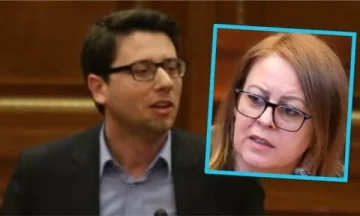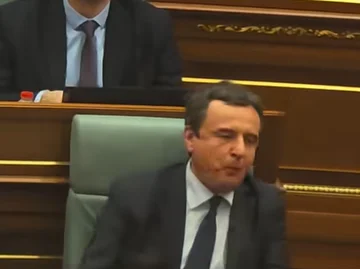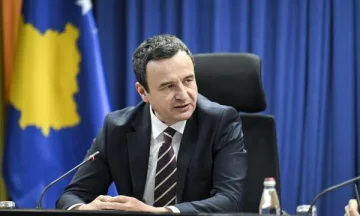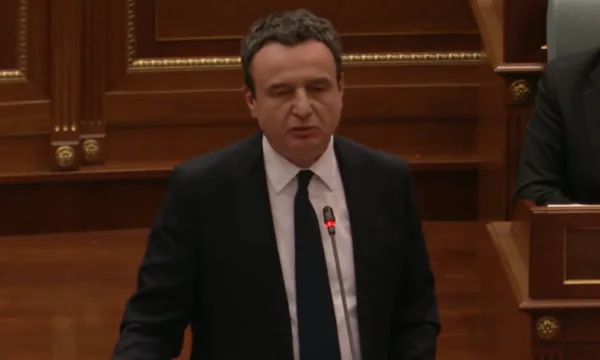
Kosovo Prime Minister Albin Kurti spoke in the Kosovo Assembly about migration, saying that, in his view, two of the main reasons driving citizens to leave the country are the quality of education and problems in the justice system.
During the discussion, Kurti said that people in Kosovo live better as citizens of the Republic than as residents of municipalities, criticizing the situation in local government, particularly in rural areas, and the quality of education, reports Ekonomia Online.
He also mentioned investments in Brezovica, which he said had been impossible until two or three years ago because of the control that, according to him, Belgrade exercised through the annex.
“It is true that we have lost a lot of time by not investing in Brezovica. But you should bear in mind that until two or three years ago it was actually impossible, because Belgrade’s annex controlled Brezovica. You know that even a small problem in Kosovo ends up in court, and once it ends up in court, you are guaranteed to face a five-year blockage. That is why it was first necessary to take control, carry out fiscalization, and appoint a new, functional board. That is why the conditions for investing in Brezovica are only now in place. Honestly, if you had invested in Brezovica 10 years ago, you would have had to reach an investment agreement with Belgrade as well. We no longer have that problem. Naturally, we will have other problems, but the precondition has been addressed,” Kurti said.
The head of government also spoke about foreign direct investment, saying it had doubled, but that its structure remained the main challenge, since, according to him, most of it continued to be concentrated in real estate.
“Foreign direct investment in Kosovo has doubled. Dear citizens and honorable members of parliament, I do not see the volume of investment as a problem at all. We have more of a problem with the structure of investment. It is still going into real estate, it is still going into apartments, it is still going into land. Land that may or may not be worked, and apartments that may or may not be lived in. But this is a societal problem as well as an economic and financial one, which perhaps we can discuss another time, because it is a deeper issue,” he said.
Kurti said that during his six years in government, he had come to the conclusion that there were two main factors influencing people’s migration, highlighting the situation in municipalities and the quality of education.
“But my conviction, after these six years in government, is that there are two main reasons for people’s migration in recent times. I am not talking about the migration that took place during Serbia’s brutal occupation, apartheid, political persecution, and then economic poverty, and so on. We will continue to face the risk of migration because of these same two factors, which I will briefly discuss now,” the prime minister said.
As the first factor, he mentioned the situation in Kosovo’s municipalities, saying that living conditions in many of them, especially in rural areas, were causing people to move to larger centers or abroad.
“The first is the situation in our municipalities. I am convinced that in Kosovo, people live much better as citizens of the Republic than as residents of a municipality. Most municipalities in Kosovo have living conditions, especially in rural areas and particularly because of the quality of education, that lead people either to move internally to Fushë Kosovë and Pristina, or to Germany and Switzerland. Believe me, one of the main causes of migration, whether internal or abroad, is education,” Kurti said.
He said that improving education was one of the biggest challenges for institutions, since the results of investments in this sector could not be seen immediately but required time and stability.
“I am also very optimistic that we will be able to put industry, defense, security, investment, culture, and sports in order. Education will remain a major challenge, because in education you have to sow this year and for the next two years in order to be able to reap in about 10–15 years. It is very slow. It requires great stability, and there are challenges that the world also faces; they are not just our challenges. What kind of school should there be in the 21st century is a legitimate question even in the most developed economies, let alone here,” he said.
Kurti also criticized the way education was organized at the local level, saying he would prefer this sector to be more centralized.
He also mentioned the decentralization of education under the Ahtisaari proposal, because of the Serb-majority municipalities, and called for greater importance to be given to municipal education directors.
“And the second factor, in my view, apart from education—specifically its quality, or rather the lack of quality—is the fact that education is the responsibility of municipalities. I would prefer education to be more centralized, I’m telling you very openly. But under the Ahtisaari proposal, because of the 10 Serb-majority municipalities, education was decentralized. Just look at the quality of the people serving as municipal education directors across Kosovo’s 38 municipalities. Unless we make the municipal education director a much more important position—one that any of us would want to take on, because it is a major challenge—education will not be fixed,” Kurti said.
He added that problems in education were more pronounced in rural areas, and noted that quality also varied between Kosovo’s different centers.
“Especially in rural areas. Things are good in these main urban centers, but then there is stratification. The capital is better off than other centers,” he said.
During his speech, Kurti also asked for a few more minutes to conclude the discussion, saying that, besides education, Kosovo’s second major challenge was justice.
“And the second, apart from education, is a major challenge for our state: justice. We have many citizens of our country who, when they have gone to the Palace of Justice and come out again, or to the basic courts and prosecutors’ offices to lodge a complaint, have left more dissatisfied than when they went in,” the prime minister said.
According to him, dissatisfaction with the justice system, injustices, and delays in court proceedings could lead people to decide to leave Kosovo with their families.
“And you know what our people are like—they move away. A problem with a neighbor, a problem at work, an injustice somewhere, a case dragging on in court—they leave with their whole family. We need to fix justice and education. To be honest, I am optimistic about everything else. I am cautiously optimistic about these two. And this is our major challenge in the years ahead,” Kurti added.