By: Baton Haxhiu
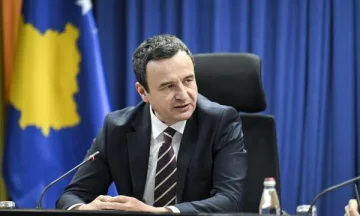
He must have meant it seriously when he said that dialogue is not only with Serbia, but also with the Western world, with our strategic friends, even with Russia—but only if it comes dressed as the president of Latvia, with a microphone in its mouth and a camera recording for YouTube.
That is how one of the most tragicomic moments in the history of Kosovo’s diplomacy began: an imaginary conversation between Kosovo’s Prime Minister and an imaginary president, in a world where only one of them was serious—the one who was real.
It’s not that he fell into a trap—others have too—but no one has fallen with this level of self-confidence, so unabashedly, without a filter, and with such a burning desire to share all his intimate thoughts about the local media, Pristina’s businesspeople, Grenell, and everything else he wasn’t asked about.
When his interlocutor tells him he is gay, our Prime Minister lights up, feels a human connection, thinks of Grenell, and says it to his face, as if to show that he is informed, that he knows things, that he is in the know—very much in the know, perhaps more than he should be.
A perfect cocktail of what in Albanian is called unrestrained, but in the language of protocol is called unprepared, and in diplomatic slang could be translated as a representation disaster.
Instead of keeping his distance, he approaches his fake interlocutor with the dedication of an ideologue who has finally found a kindred spirit. He starts talking about hybrid warfare, the media being under influence, people who are a problem, Serbia, Russia, the whole world—everyone but himself, who is caught in a trap and doesn’t even know it.
The very person who speaks out against Russian and Serbian influence is the one speaking eagerly with a textbook product of hybrid warfare. That is the complete irony, and it needs no explanation. Just look at it.
All that’s missing is for Kurti to tell the imaginary president, “Come on, when you’re in Pristina, we’ll take you to ‘Soma’ with the gang,” because diplomatic distance is for bureaucrats. Kurti does diplomacy the way he debates in a TV studio—with nerves, passion, and no restraint.
It’s a version of a chat in the courtyard with the neighborhood, drinking rakia, where people, labels, denunciations, and personal feelings are brought up, as if he were talking to his uncle at a café, and not to someone he believes to be a European leader.
Is this an isolated episode, or a window into how he talks with other world leaders? If Macron, Scholz, or Grenell have heard the same repertoire, then Kosovo’s history has entered its most theatrical phase, where the leading actor can no longer distinguish between reality and improvisation.
A video that makes you laugh until you cry—but not with joy; it’s the kind of laughter that catches in your throat, and when it’s over, you feel like saying, “I can’t believe this man represents my state.”
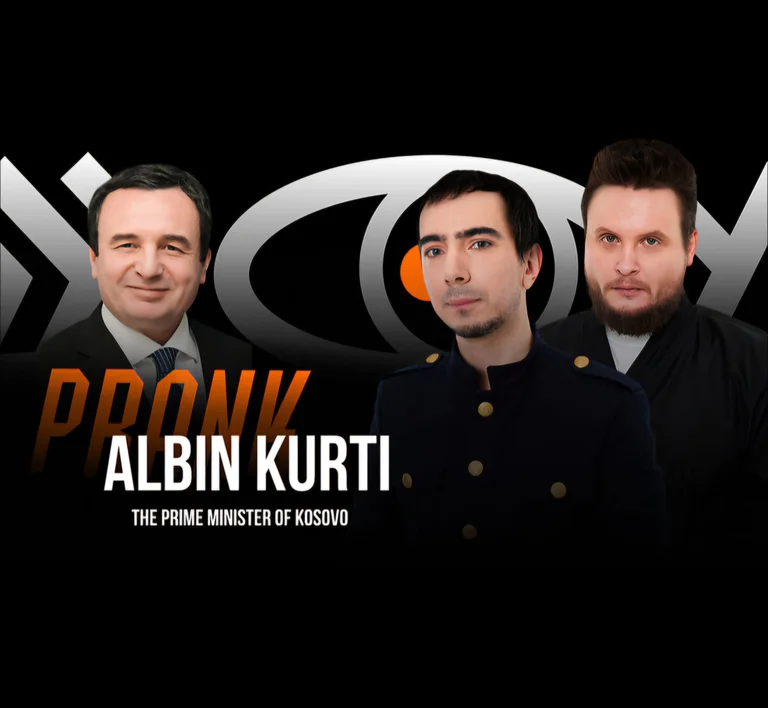
An amateur spectacle, staged by two Russian comedians, who themselves had not imagined how much comedic material they would get out of a prime minister who takes himself very seriously, but nobody else seriously, and who speaks with the conviction that every word he utters is a prophecy—even as he falls headfirst into the most banal trap of Russian intelligence.
Because, in the end, this is not simply mockery; it is a slap in the face of institutional seriousness, a call to understand that if we still don’t have a protocol for verifying who is on the other end of the line, we need neither foreign policy nor strategy nor coordination. All it takes is a microphone and a Zoom call, and we become the laughingstock of the world.
For those who see this as something to move past, a human error, an incident without weight, we have just one friendly appeal: laugh now, while we’re alive, because by the time we cry, it will be too late.