By: Evan Medeiros / The Financial Times
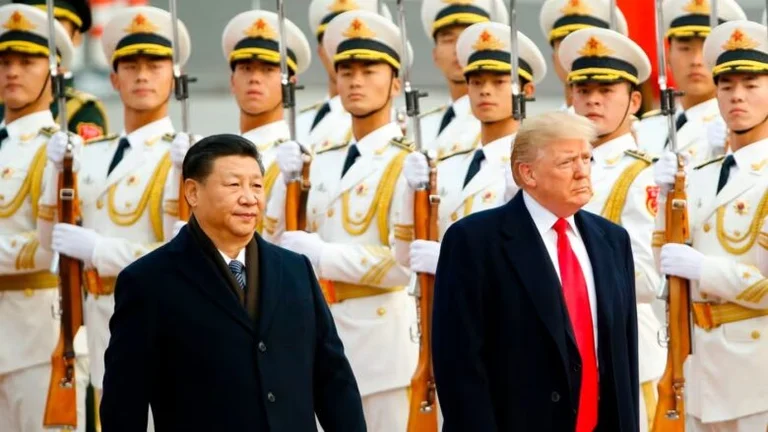
If Donald Trump’s China policy is characterized by uncertainty and contradiction, Xi Jinping’s strategy is defined by clarity and determination. The Chinese president’s approach to the U.S. president-elect is no secret. Since the election, Beijing has been quite clear about its positions and possible responses.
Xi plans not only to respond, but also to benefit from Trump’s moves. During Trump’s first term, Beijing rushed to react. Now it is determined not to repeat that. Xi is already engaged in his own preparations and has given signals to that effect.
Most Chinese analysts were not surprised by Trump’s victory, linking his return to a global wave of populism and nationalism. Beijing believes it already understands Trump’s game strategy and can manipulate his administration. China’s confidence is based on the conclusion—whether accurate or not—that China in 2025 is different from China in 2017, just as the U.S. and the world are, too.
Many Chinese argue that Xi is politically more powerful and that the economy is more independent and resilient, despite recent challenges. Chinese analysts see the U.S. economy as more fragile and American politics as deeply divided. Geopolitically, Beijing sees U.S. influence declining across the Global South and Asia—while support for China’s vision is growing.
Xi has already signaled that he will treat his relationship with Trump as a purely business connection, in the style of Don Corleone. He will not personally embrace Trump and will retaliate early and forcefully to create leverage. Beijing in fact declined Trump’s invitation for Xi to attend the inauguration.
Nevertheless, Beijing is also signaling that it wants dialogue and is open to a deal to avoid new tariffs. The Chinese, however, who prefer to use informal channels, are trying to find the right one to understand what Trump “really” wants. Beijing’s basic assumption is that Washington and its allies will remain hostile toward China for the foreseeable future. Xi is therefore open to negotiations because he wants breathing room on the economic front, so that China can mobilize its forces for a long-term contest.
Beijing remains concerned that Trump’s team will focus on deeper economic decoupling, regime change in China, and support for Taiwan’s independence—all as ways to contain and destabilize China. For this reason, Xi set out four “red lines” at a meeting with President Joe Biden in Peru in November, sending a clear message to the incoming administration.
Beijing’s planned responses to Trump fall into three categories: retaliation, adaptation, and diversification. Reflecting U.S. policies, Beijing has in recent years developed a range of measures, such as export controls, investment restrictions, and regulatory investigations that could harm American companies. Since China is unable to respond with equivalent tariffs, it will try to impose costs in ways that inflict maximum pain. For China, not responding would signal weakness at home and encourage Trump.
This has already begun. In late 2024, Beijing blocked exports to the U.S. of critical minerals used in chipmaking, restricted the supply chain for U.S.-made drones, threatened to blacklist a well-known American apparel company, and launched an antitrust investigation into Nvidia. By taking these actions, Beijing is demonstrating its capabilities and creating “trade assets” for the future.
China’s second strategy is adaptation. From the fall of 2023, Beijing began a powerful fiscal and monetary stimulus to help businesses and, later, consumers. This policy shift is generating some positive effects, although they are uneven. It was clearly necessary, but its scope and nature were also shaped with a possible trade war in mind.
Beijing’s third strategy involves expanding economic ties. It is considering unilateral tariff cuts on imports from non-American partners. During his visit to Peru, Xi inaugurated a deep-water port that could reshape China’s trade with Latin America—a major source outside the U.S. of food, energy, and minerals. In late 2024, Xi attended meetings with the heads of 10 major international economic organizations for the first time. His message was clear: China will be the leading force for global stability, prosperity, and economic openness, and opposes all forms of protectionism.
Many things could go wrong. Beijing’s self-confidence matches that of Trump’s team. Both sides believe they have the upper hand, that they can impose greater costs and withstand more pain. The stage is set for a complicated and destabilizing dynamic that, at best, ends in a truce. And that is only on economic issues—not Taiwan, the South China Sea, technological competition, or the modernization of nuclear forces. The Cold War has begun to look simple compared with the challenges we face today. /Telegrafi/