Source: The Guardian
Democracy is dying across the globe. This may seem alarming and prompt the next question: what does this really mean? Does it mean there will be no more elections? Or will the opposition be criminalised? If these are the criteria, then Vladimir Putin’s Russia remains a democracy. Six political parties are represented in the State Duma, Russia’s federal parliament, and more than 20 political parties are registered. Yet, as you may understand, Russia is not a democracy: in fact, it is a state that has gone beyond authoritarianism and is heading towards totalitarianism, with more Russians being prosecuted for political activity than during the time of Joseph Stalin.
Faith in democracy is undoubtedly declining. A new study found that a fifth of Britons under the age of 45 believe the best system for governing a country effectively is “a strong leader who doesn’t have to worry about elections”, compared with just eight per cent of older people. This reflects other findings around the world. A study conducted by Cambridge researchers in 2020 examined attitudes in 160 countries and found that younger generations “have become increasingly disillusioned with democracy”. According to the PEW Research Center, almost two-thirds of citizens in 12 high-income countries were dissatisfied with democracy in 2024 – compared with just under half in 2017.
Why is this happening? An economic model that produces stagnation and insecurity has a lot to explain. The Cambridge study concluded that economic exclusion was the main reason for dissatisfaction among young people. Russia’s experience offers lessons. When the Soviet Union collapsed, the new Russian president, Boris Yeltsin, declared in 1990: “We can ensure that people’s living standards do not fall and, in fact, they should rise over time.” Within four years, Russians’ real incomes had halved, with 32 million Russians falling into poverty as a result of “shock therapy” policies. By 2021, only 16 per cent of Russians supported the “Western model of democracy”. The chaos of free-market capitalism was handed over under the banner of democracy, producing a sense of disillusionment that Putin skilfully exploited.
Britain has not experienced the horrors of Russia in the 1990s. Nevertheless, a toxic combination of neoliberal economic policies and austerity measures has hit young people hard. Thatcherism promised freedom, but instead brought insecurity. Secure jobs have disappeared, rents have risen, wages have fallen, youth services have been decimated and graduates face huge debts to attend university. Young Britons have borne the brunt of policies that most of them never voted for. It is no wonder that democracy seems increasingly inaccessible to them and to their peers in other countries that have suffered the harsher side of neoliberalism. In France, for example, almost a third of young people say they have lost faith in democracy.
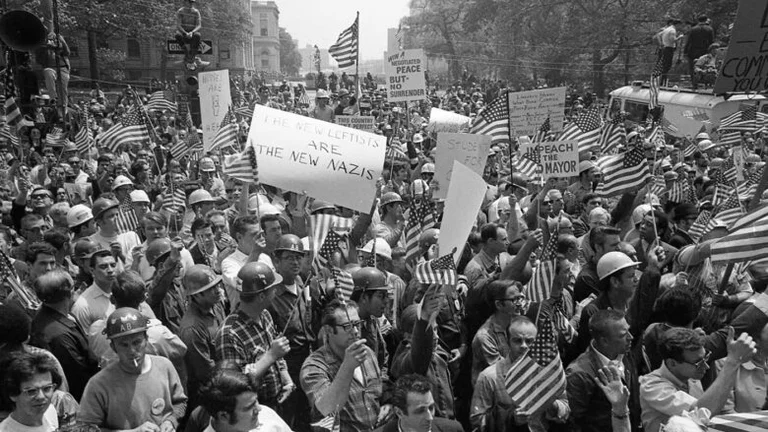
However, something else is also at play. Take the example of the United States. The 1960s and 1970s offered an endlessly fertile ground for a figure like Trump to emerge and triumph. The economy was in crisis – a toxic mix of high inflation and stagnant growth. There was a violent racist backlash against the civil rights movement, as well as unrest across the US. Violent crime rose to far higher levels than today, with murders doubling between the mid-1960s and the late 1970s. After almost 60,000 US soldiers died in the Vietnam War, the conflict ended in humiliating defeat and a sense spread that the US was a declining power. The backlash against the left was much broader, as illustrated by the “hard hat riot” of 8 May 1970, when hundreds of construction workers violently attacked anti-war protesters in New York.
The closest equivalent to Trump in the mainstream politics of that time was George Wallace, a racist and segregationist who was nevertheless less harsh and less demagogic than the current president-elect. He won 13.5 per cent of the vote in the 1968 presidential election, and the US ended up with Richard Nixon and then Ronald Reagan, a right-wing figure, but of a somewhat different nature. In fact, the US of the 1930s showed a much greater receptiveness to fascist sympathies than during the 1960s and 1970s. The Nazi-sympathising priest Charles Coughlin boasted that his radio programme had 30 million listeners, at a time when the US population was less than 130 million; one poll suggested that he ranked second in popularity and power, after President Franklin D. Roosevelt.
What has changed? The shadows of the fascist experience of the 1930s, which led to a genocidal war of extermination, have lost their power. The stigma of dictatorship and right-wing extremism has faded. American voters in the 1970s may have been deeply disillusioned, but they would have looked at Trump and worried that he had too many shades of Mussolini, too many echoes of Hitler. That fear no longer plays a role.
Democracy under capitalism has always been heavily constrained by corporate interests and plutocrats, who have enjoyed far more power than the average voter. When capitalism falls into crisis, as it did in 2008, its deep flaws generate popular anger. The question is who channels that anger. One major danger is that the rising far right has developed a destructive and extraordinarily successful strategy on social media, radicalising an ever-growing number of followers, while the left is far behind in this regard.
People are right to be angry, but that anger is being directed at entirely the wrong targets. Faith in democracy is collapsing because of a failing economic system, and if convincing answers to this crisis are not offered, this could prove fatal. /Telegrafi/