For more than 25 years, I have had the privilege of directing programs funded by the U.S. Government to promote democracy, good governance, and security in complex regions: from the Balkans to the former Soviet states and all the way to the Middle East.
I have had the good fortune to witness the Orange Revolution in Ukraine and democratic developments in Georgia, when these countries sought to break away from Russian influence, as well as the entire wave of the Arab Spring. I have directed programs to combat terrorism and violent extremism in conflict and insecurity zones. I have seen up close societies protesting for justice, dignity, and accountability; but I have also seen cases in which the protests of honest citizens are instrumentalized, distorted, and used as a tool for interests unrelated to democracy.
That is why I say this with a sense of responsibility: the difference between a sincere revolt and an organized smear campaign is not always visible on the first day, but it becomes clear when we see who benefits from weakening the state.
Albania’s Success and Progress Will Not Be Stopped
Today’s Albania is not the Albania of isolation, institutional chaos, or aimless transition. Under the leadership of Edi Rama and his government, the country has taken important steps on its European path, strengthened its international profile, developed tourism, attracted strategic investment, modernized infrastructure, increased Albania’s role in NATO, and maintained a clear pro-Western orientation in turbulent geopolitical times.
This is also best reflected in assessments by international institutions such as the World Bank and the International Monetary Fund, according to which the Albanian economy is expected to continue growing significantly faster than the European Union average in the coming years, with projections putting Albania’s growth at around 3.4–3.8%, while EU growth remains at approximately 1.1–1.5%. This does not mean that everything is perfect; but it does mean that Albania is heading in the right direction.
So the question arises: who, then, benefits from smearing this government?
Who benefits when Albania is portrayed as an unsafe country for investors? Who benefits when every major project is attacked before it is examined on the basis of facts? Who benefits when reform, development, and strategic partnerships are treated not as national opportunities, but as objects of political strife? In a democracy, criticism is essential. Transparency is essential.
Environmental protection is essential. But destroying trust in the state, in institutions, and in Albania’s strategic friends is not patriotism; it is serving agendas that want Albania to be small, divided, and held back.
Serbo-Russian Interests
It is no secret that Serbo-Russian interests in the Balkans have historically been linked to weakening Euro-Atlantic projects. An Albania moving toward the EU, strengthening its partnership with the United States, supporting Kosovo, standing aligned with NATO and with Western sanctions against Russian aggression, does not suit either Moscow or those circles in Belgrade that still view the region through the logic of domination.
Russia wants a Balkans that is frozen, divided, and weary of democracy. Nationalist Serbia wants Albanians to appear as a problem, not as a stabilizing force. That is why every success for Albania is a concern for those who want to keep the region hostage to the past. Aleksandar Vučić, too, has a clear political interest in Albania not advancing rapidly in the process of European integration.
An Albania drawing closer to the EU, strengthening its institutions, and gaining diplomatic clout changes the balance in the region. It makes the Serbian narrative that Albanians are a destabilizing force harder to sustain. It strengthens Kosovo’s voice. It makes more visible the contrast between a country moving with the West and a Serbian policy that often wavers between Brussels and Moscow.
For official Belgrade, a successful Albania is not merely a regional competitor; it is evidence that the Albanian Euro-Atlantic project is gaining ground.
Anti-Albanian Elements in Europe
At the same time, within some European countries there are elements of the radical left and radical right that fuel old prejudices against Albanians. The far right often views Albanians through the lenses of immigration, crime, and cultural fear. The far left, in some cases, views strategic investments, partnerships with the United States, and tourism development as signs of “unbridled capitalism,” without acknowledging that small countries need capital, jobs, and economic integration. These two extremes, even when they start from different positions, meet at one point: they want to portray Albania as a problem, not as a success story.
Historically, the European political scene has included elements and circles that, driven by ideological interests, ties to Moscow, affinity with Serbian narratives, or old anti-Albanian prejudices, have worked against the progress of Albania and Albanians on the Euro-Atlantic path. These circles have often viewed Albania’s empowerment, support for Kosovo, and consolidation of the Albanian factor in the Balkans not as a contribution to regional stability, but as a threat to the old balances that served Russian influence and Serbian nationalist interests. Therefore, whenever Albania draws closer to the EU, strengthens its alliance with the United States, and takes on a more important regional role, these voices mobilize to relativize, obstruct, or smear this progress.
There is another dimension as well: some foreign interests seek to use Albania as a springboard to attack President Donald Trump and his family. Instead of projects being discussed thoughtfully, in accordance with the law, environmental standards, and institutional transparency, they are immediately turned into weapons in their political war. Albania must not become the stage for anyone’s internal battles. Albania must defend its own national interest: serious investment, environmental protection, partnership with the United States, and development that serves Albanian citizens.
Therefore, today’s debate should not be between those who want development and those who want nature; Albania needs both. The real debate is between those who want to build the state to high standards and those who want to destroy trust in every success. Between those who demand transparency and those who seek chaos. Between those who want Albania in Europe and those who benefit when Albania is held back on the doorstep of Europe.
Protest is an essential part of democracy, and no one should deny citizens the right to speak up, demand accountability, and oppose public decisions. But in a serious democracy, protest cannot automatically be used as a reason to disregard the free will of citizens expressed in elections just one year ago. There are protests in every country in the world—in Europe, in America, in the most developed democratic societies—but nowhere can they replace institutions, elections, and the political mandate given by the people. Democracy is not only the right to protest; it is also respect for the result of the ballot box, until citizens decide otherwise in the next elections. I believe Albania should continue moving forward. With accountability, but not with public vilification.
With the protection of the public interest, but not in service of foreign interests. Because today, more than ever, Albania needs strategic clarity: to move toward the EU, strengthen its alliance with the United States, protect Kosovo, attract serious investment, and not allow temporary noise to halt its historic path.
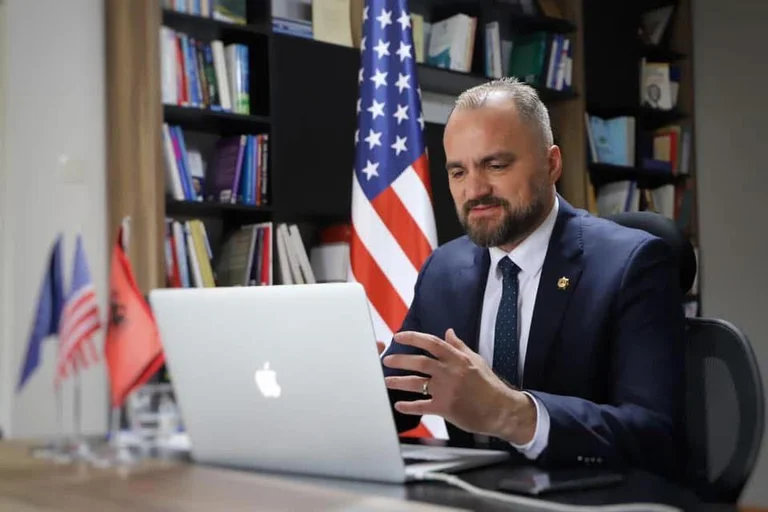
Arianit Shehu serves as Executive Director of the American Center for Combating Terrorism and Extremism, based in the United States of America. For more than two decades, he has served as a Senior Director at the American National Democratic Institute in more than 20 countries. He has also served for many years as an adviser to former U.S. Secretary of State Madeleine Albright at the Aspen Institute and the Atlantic Council. During the war in Kosovo, Mr. Shehu served as a war correspondent for the prestigious Los Angeles Times newspaper. He also lectures at the University of Philadelphia.