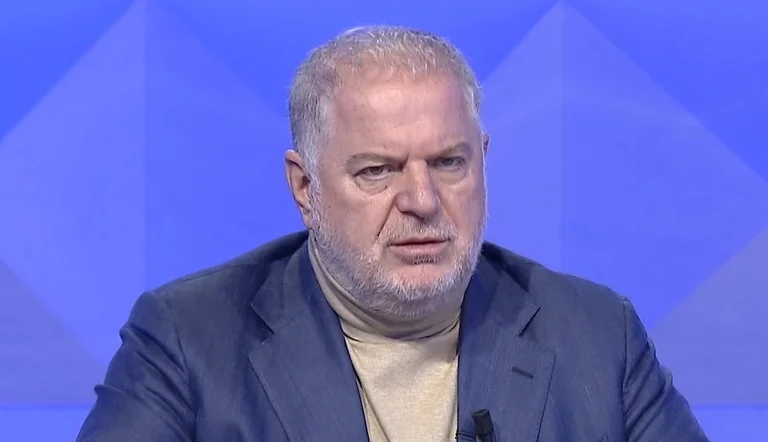
From a public sentence to criminal proceedings, the case of prosecutor Arianit Salihu and the dangerous boundary between interpretation and law
Written by Baton Haxhiu
A prosecutor at the Basic Court, named Arianit Salihu, had authorized two investigators to interview me about a public statement of mine, turning a political analysis into a procedural matter. Today I was at the police station. And what I saw was not just a procedure, but a misunderstanding that has taken institutional form.
I was not there for an act, a fact, or an event that needed to be clarified. I was there for a sentence, and to respect the institution, even though I made it clear to them that this was regrettable.
A sentence spoken publicly, in a television studio, in a complete context, heard and understood by the public.
The two investigators were courteous. Professional. And at one point, in a conversation that went beyond formalities, they told me that the case had been initiated by the prosecutor. And that for them, this was a professional obligation.
That is when I felt sorry.
Because this was no longer a matter of an invitation. It was a matter of how my words had been read.
And when a citizen misreads words, it is a misunderstanding. When an analyst misreads them, it is a debate. But when a prosecutor misreads them and turns them into proceedings, then we have a problem, because a prosecutor cannot afford to misread.
They must distinguish between words and actions. Between metaphor and a call to action. Between analysis and incitement.
In this case, what has happened can have only three explanations.
Either it is a problem of reading and education, that is, an inability to understand a text in its entirety.
Or it is malice, that is, a willingness to distort the meaning of a statement.
Or it is political pressure, that is, the use of an institution beyond its purpose.
All three are serious. All three are unacceptable. And all three, for a prosecutor, are an ethical catastrophe.
Because this is not a secret statement. This is a public analysis. And public analysis is not read with tweezers; it is read in its entirety.
For this reason, I am addressing you, prosecutor Arianit, not to defend myself, because that is simple in this case. But I felt sorry for you and the prosecution.
I am addressing you to defend a standard that is greater than any individual. Because the moment a prosecutor begins investigating how people speak, and not what they do, they move away from the law and into interpretation; and for your information, even formally, interpreting words is not a criminal-law competence.
Below I am reminding you of the text I left with the investigators, which remains unchanged and represents my position in its entirety. This text was a message to you, Mr. Prosecutor, Arianit Salihu.
What concerns me in this case is not the invitation itself, but the logic on which it was based.
You, prosecutor Arianit Salihu, have taken a fragment excerpted from a complete political analysis and removed it from its natural context, in order to treat it as an object of investigation. This is not simply a misinterpretation. It is a dangerous way of understanding public speech.
Because in a democratic society, words are not read in isolated fragments, but in their full meaning. Otherwise, every metaphor can be criminalized, every criticism can become a criminal suspicion, and every political analysis can be treated as a threat.
My statement is clear to anyone who reads it in its entirety. I state explicitly: “no one is talking about the crisis anymore… we have lost so much in this country and we are dealing with procedures,” thereby setting the context of a criticism of the general situation, and not of the legal order.
Further, I articulate two paths that are within democratic logic: “either let them give the man 80 votes, or let them show that he is not ready to govern,” which is a clear reference to parliamentary functioning and political legitimacy, not to any unlawful act.
Even the expression used, “get rid of him by any means,” is part of figurative political language, which is immediately clarified by the context itself: “either give him 80 votes, or remove him so others can govern,” that is, through democratic and constitutional means.
Indeed, at the end I make the boundary clear: “our constitutional system does not allow this, it does not make it possible,” which is a direct affirmation of the constitutional order, not a denial of it.
In this sense, we are not dealing with a statement that calls for an investigation, but with a political analysis that calls for a complete reading. Turning such an analysis into an object of proceedings is not merely a misinterpretation, but a problematic shift in the boundary between free speech and institutional intervention.
If this way of reading becomes the standard, then we no longer have a problem with a statement, but with the very space for free thought. And that is what makes this case a dangerous precedent.
Because a state that begins investigating how people speak, and not what they do, enters a territory where the boundary between justice and control over thought begins to blur. And for the institutions themselves, this is a wrong path.
I have no hesitation about clarifying anything I have said. On the contrary. But it is just as important to clarify this: political analysis is not a criminal matter and cannot be treated as such.
This is not a personal matter, but it is a test of how justice understands its limits.
And if this boundary begins to be built on misreadings, then the problem is not with the words. It is with the authority that reads them. With a prosecutor like Arianit Salihu, who wants authority over nothing. And authority cannot be built on a vacuum.
P.S. My full statement on T7
No one is talking about the crisis anymore. Nor about well-being, nor about how a citizen lives. There is no talk about infrastructure, whether educational or health-related, nor about roads, nor about energy. We have lost so much in this country and meanwhile we are dealing with procedures. This is regrettable.
What I want to say is this. Citizens should prepare for two possibilities. Either give the man 80 votes. Or show that he is not ready to govern. Because this no longer makes any sense. Citizens are playing with themselves.
“Get rid of him by any means” is a call expressed in figurative political language, which is immediately clarified: either give him 80 votes, or remove him and let others govern. Because we are tired.
For two and a half years, he has been governing outside the procedures. The “80” metaphor refers precisely to this collective exhaustion, the endless wait for one man to realize a model of power similar to that of Edi Rama, Mickocki, or Vučić.
But this is not possible. Our constitutional system does not allow it. It does not make it possible.