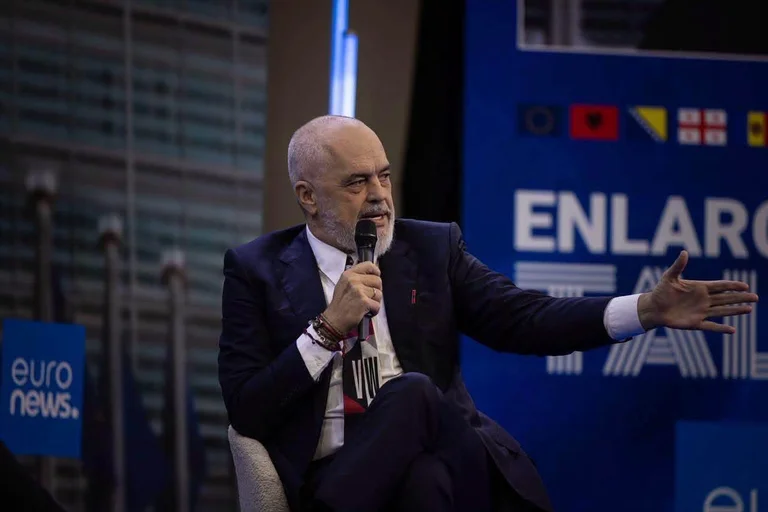
Albanian Prime Minister Edi Rama said today that it is still too early to be enthusiastic about the latest political developments in Serbia and their impact on the region’s European integration process.
During a discussion in Dublin (Ireland) with an audience of European and Balkan experts and diplomats, organized by the Institute of International and European Affairs (IIEA) on the topic “Albania’s European Journey: From Aspiration to Integration,” Rama said that the European Commission had problems in its dealings with the previous Serbian administration, particularly on issues related to the rule of law and meeting the European Union’s fundamental requirements.
“It is much too early to say anything precisely about what comes next,” Rama said.
The head of government described the political developments in Serbia as a social and political experiment, referring to the so-called Student List and the method for selecting the people who will be part of parliament or government.
“Serbia is going through a social and political experiment, the so-called Student List, with this method of selecting and electing the people who will be in parliament or government. It is something quite new in many respects,” he said.
Speaking about the impact these developments could have on regional relations, Rama stressed that, from Albania’s perspective, there is still no clear opening by Belgrade on the issues most important to the region’s stability and integration.
“As long as there is no open approach toward Kosovo and normalization with it, that means the ghost of the past will continue to haunt Belgrade and will continue to prevent the Serbian nation from carrying out such a necessary catharsis, which is still lacking,” Rama said.