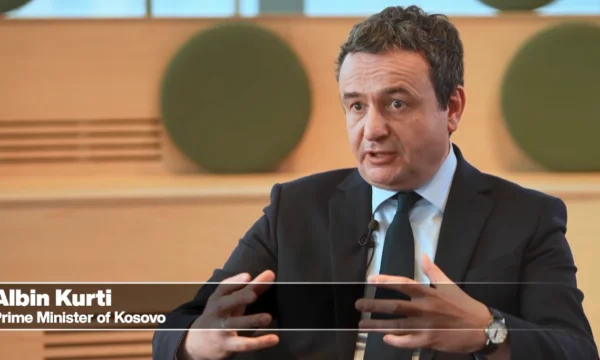
Kosovo’s Prime Minister, Albin Kurti, said in an interview with French television channel France 24 that he expects Kosovo to receive candidate-country status for membership in the European Union in the coming weeks or months.
In the interview, Kurti expressed regret that Kosovo, four years after applying for EU membership, still has not received candidate-country status.
He said Kosovo is the only country in Europe without this status, attributing the delay to the fact that the European Council has not asked the European Commission to prepare an opinion on Kosovo’s application.
“We have completed all our tasks in terms of democratic indices, the rule of law, the fight against corruption, transparency, press freedom, electoral democracy and liberal democracy,” Kurti said.
He emphasized that Kosovo is not seeking preferential treatment in the European integration process, but a merit-based process.
“We do not want shortcuts, back doors or expedited procedures. We want a merit-based process, and we are ready for it. We are ready to respond with commitment and care to the thousands of questions in the questionnaire that has still not been sent to us,” he said.
Kurti cited internal dynamics within the EU Council as the reason for the delay in starting this process, referring to the five states that do not recognize Kosovo’s independence: Spain, Cyprus, Romania, Greece and Slovakia.
Asked whether Kosovo could change these countries’ positions, Kurti said that cooperation and communication with them had increased.
He cited Spain’s recognition of Kosovo passports and the upgrading of the status of Kosovo’s office in Athens as examples.
“We have asked them to join the majority, the 22 EU member states that recognize us. There has been some gradual progress. These are positive signs, but recognition has not yet happened,” Kurti said.
However, he said that the five non-recognizing states do not pose an obstacle to sending Kosovo the questionnaire as part of the membership process.
Speaking about the European Commission’s criticism of reforms in Kosovo, particularly regarding the independence of the judiciary, Kurti acknowledged that there were concerns about the justice system, but said that this was precisely why reforms had been launched.
He announced that Kosovo was close to establishing a bureau for verifying and confiscating assets acquired unjustifiably.
“So, you cannot have an average salary and a large villa, or several of them,” Kurti said.
According to him, the EU integration process, through the opening and closing of chapters and clusters of chapters, would help Kosovo further reform its justice system and public administration.
In the part of the interview concerning Kosovo-Serbia relations, Kurti said it was still too early to assess whether a new chapter in relations between the two countries could open after the elections in Serbia.
However, he reiterated that Kosovo aims for full normalization of relations with Serbia, centered on mutual recognition.
“We want full normalization of relations with Serbia, centered on mutual recognition. There is no time machine to go back to the 20th century,” Kurti said.
He added that Kosovo is an independent state and a democratic republic, and said that the sooner Belgrade accepts this reality, the better it will be for relations between the two countries and for Serbia’s path toward the European Union.