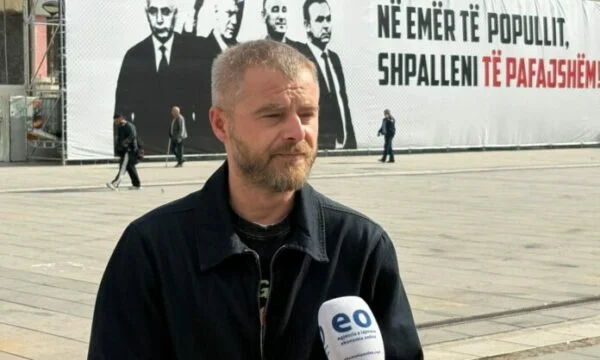
Ismail Tasholli has published a Facebook post in which he drew a parallel between Jakup Krasniqi’s sentence under the Yugoslav system and the judicial proceedings against him at the Kosovo Specialist Chambers in The Hague.
In an analysis titled “Two prisons, one man,” Tasholli interpreted Krasniqi’s biography as a confrontation with two different ideological systems which, he says, used similar mechanisms of punishment against the same individual.
He recalled that Krasniqi was sentenced by the Yugoslav system for propaganda and activities against the order of the time, while now he is facing international justice on charges that Tasholli describes as connected to propaganda and the mobilization of citizens in the war for freedom.
“Two historical orders, claiming to represent entirely different norms, end up using similar mechanisms of punishment against the same individual,” Tasholli wrote.
Tasholli referred to the work “Discipline and Punish” by French philosopher Michel Foucault, raising the question of how systems that legitimize themselves through different principles can use the same mechanisms to exercise power over the individual.
According to Tasholli, when politics needs to use a person as a means, the forms of government or the principles institutions claim to uphold matter little.
He also criticized European institutions, calling on them not to speak in the name of justice if they themselves do not respect the principles they promote.
“Because you cannot invoke the Kantian principles of human dignity and, at the same time, treat a person as a means to political ends. The Kantian principle is clear: a person must always be treated as an end in themselves, and never merely as a tool,” he wrote.
Finally, Tasholli argued that justice which uses the individual as a means to political ends ceases to be justice in the moral sense and becomes another form of exercising power, wrapped in principles that it itself violates.