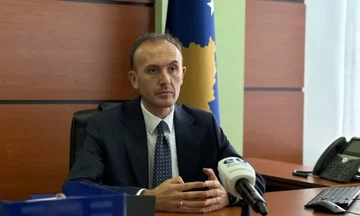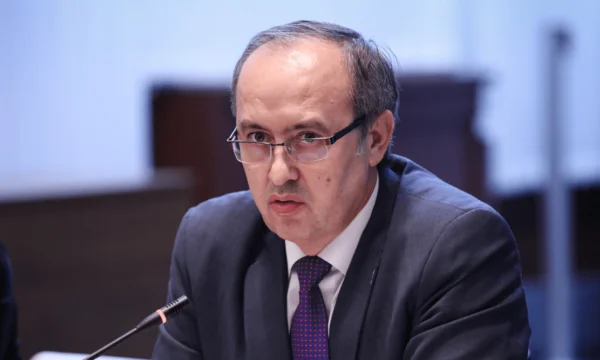
Avdullah Hoti, an MP from the Democratic League of Kosovo, criticizes the Government for failing to take economic measures to cope with the consequences of the global price crisis, saying that sufficient policies have not been undertaken to ease the burden on businesses and citizens.
According to him, Kosovo's economy is facing insufficient growth rates, while businesses are being burdened with bills three times higher because of high electricity costs.
In an interview with KosovaPress, Hoti also says that the draft budget for 2027 has no focus on the country's economic development.
He considers that one-off aid for citizens and families does not solve the economic problem, since, according to him, a government's role is to cushion the impact of international crises on the domestic economy.
“We have shared the fate of developments taking place around the world. But the problem is that no measures have been taken from 2022 onward to ease the burden on the domestic economy, businesses, and citizens from these international developments, mainly as a result of rising energy prices and then all other products, and then fuel prices as well. Most countries in Europe immediately took measures starting in 2022, such as temporary deferrals of payment of various taxes, for example, reducing VAT on consumer goods, reducing VAT and other tax charges on gas, energy, and fuel,” Hoti says.
Speaking about the energy sector, Hoti criticized the cancellation of the New Kosovo and gas projects, saying that the country would today have additional production capacity and better prospects for energy security.
He says that even at the end of 2026 there is no clear vision for a long-term solution to the energy problem.
Hoti stresses that, according to him, the costs of energy imports have been so high that two power plants could have been built with that money.
“Two major energy projects, New Kosovo and the gas project, have both been canceled by this government. Today, I am convinced that New Kosovo might perhaps be operational. I believe it would have been completed. Despite all the delays that may have occurred, it would have been completed, and today we would have 500 megawatts of energy at 80 euros per megawatt-hour. And for 20 years, we would have solved the problem not only of domestic supply, together with the existing power plants, but also of becoming an energy exporter; perhaps we would export 20–30 percent,” Hoti said.
He also directed criticism at the draft budget for 2027, which he described as accounting-based planning, without clear direction for economic development.
“The budget is a poor accounting plan that leads nowhere. Let alone any more advanced direction, such as fiscal policies. What will we do with fiscal policies? How will we develop industrial policies, because the world is now returning to the industrial policies of previous years, as international trade is becoming increasingly fragmented and each country is returning to industrial policies to develop the economic sectors in which it has a comparative advantage. There is no mention of these, nor of fiscal or industrial policies,” Hoti stresses.
Regarding budget expenditures, the former prime minister raised concerns about the low level of capital investment implementation during the 2021–2026 period.
“In our case, the budget deficit is planned because we have low public debt. That is, a deficit of around 2 percent is planned in the budget every year. But when the end of the year comes, this deficit almost goes to zero, because the budget is not implemented. The implementation of capital investments is very low year after year. So, if we look at the budget, for example, or take the total figure for the years 2021–2026, the total budget managed by the Vetëvendosje Government was 17-point-something billion euros,” Hoti points out.
Hoti also speaks about the economic growth rate, saying that average growth of around four percent in recent years is not enough to create jobs and narrow the development gap with countries in the region.
“The figures are what they are, on average over these five or six years, excluding the pandemic year, when we also had a decline in 2020 and considerable growth in 2021. So, if we exclude these years with major fluctuations, economic growth has been somewhere around 4 percent annually, which is insufficient to absorb the large number of people waiting for work and joining the workforce every year,” Hoti stresses.