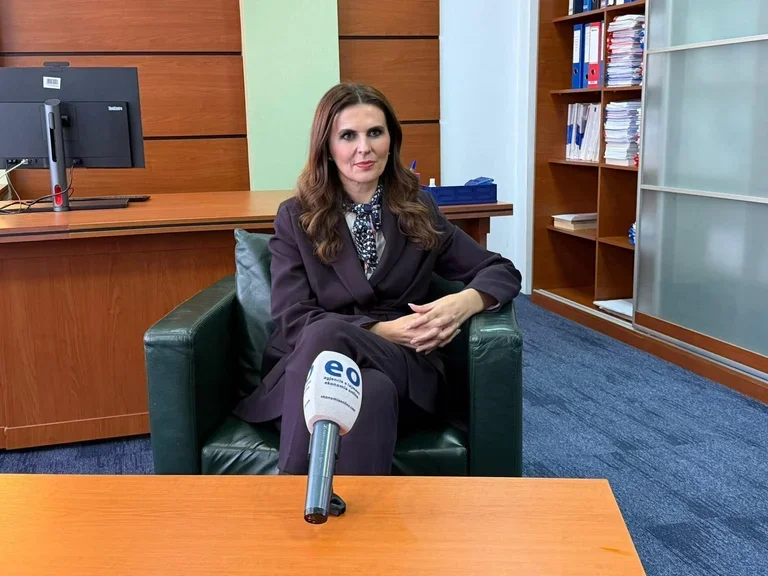
Acting chair of the Democratic Party of Kosovo (PDK), Vlora Çitaku, spoke in an interview about the Law on the Specialist Chambers, saying that the process of amending it will begin on Monday, while the aim is to complete the proposed changes within two weeks and return the law to the Assembly for a vote.
Çitaku thanked the MPs who voted for the initiative, describing the vote as evidence of political maturity and the national will to unite around the values that, according to her, the Kosovo Liberation Army represents.
“Thank you to everyone who, with their vote today, once again demonstrated a high degree of political maturity and national awareness. We are different political entities, but it is important that when history and our homeland call on us, we know how to unite around the most sublime value our nation has produced in the last century: the Kosovo Liberation Army,” Çitaku said.
She stressed that the law is not an initiative of a single political party, but a product of the Assembly of the Republic of Kosovo, adding that the process of making changes would begin immediately after the vote.
“This law is not for the PDK, it is not for political parties, this law does not belong only to the PDK; it is the law of the Assembly of the Republic of Kosovo, which we believe will pass today. The amendment phase will begin, as we pledged publicly, immediately on Monday, and, as we again pledged publicly, it will be completed within two weeks,” she told Ekonomia Online.
Çitaku also explained why the PDK had asked the president to return the law for reconsideration. According to her, the party’s position was that the Assembly’s Rules of Procedure and Article 84 of the Constitution allow the Assembly to make changes to the law.
She said that although there had been agreement with Vetëvendosje on the law’s content, the differences concerned the procedure, and it was therefore considered necessary to republish the law first in its previous form and then begin the amendment process.
“When we asked the president to return the law for reconsideration, we were convinced, as we remain convinced today, that the Assembly’s Rules of Procedure and Article 84 allow the Assembly of the Republic of Kosovo to make changes to the law. We agreed with Vetëvendosje on the content, but we had differing views on the procedure. We believe that a law of such great importance should not be accompanied by such doubts, so we broadly agreed to first republish the law as it was and immediately begin amending it,” Çitaku said.
Asked how soon the law is expected to be amended with the requested changes, Çitaku said the new legislative initiative would be submitted on Monday, and is expected to return to the Assembly for a vote within two weeks.
“On Monday, starting Monday, we will bring forward the new legislative initiative with the proposed changes, and within two weeks we will bring it back to the Assembly for a vote. It is important to say that the aim of this process, which we have now been going through for several weeks, is to strengthen the law and make it even more legally robust against any kind of challenge that could be brought against it,” she stressed.
She underlined that the law is only one of the instruments for supporting former members of the Kosovo Liberation Army, adding that they need broader state and institutional support.
“We are aware that the law is only the first instrument, and our liberation fighters in The Hague need state and institutional support. We are coordinating this process together in the strategic group,” Çitaku said.
Meanwhile, regarding the possibility of consultations with international representatives and other political parties during the amendment process, Çitaku said that the PDK is open to discussions and consultations with all interested parties.
She stressed that her party had been ready for consultations earlier as well, but, according to her, the inability to change the law at that stage meant that the consultations would not have had the desired effect.
“Certainly. In fact, we were open to consultations even now, but since it was made impossible to change the law, consultation lost its real value. We are open and invite both the European Union and other interested parties, civil society, and anyone with concerns about the law that will come before the Assembly of the Republic of Kosovo. We are open to listening to them,” she said.
In this context, Çitaku insisted that the purpose of the law is not to interfere with justice, but, according to her, to improve a process that she considers distorted.
“It is very important to underline this: This law is in no way, shape or form an attempt to influence justice. On the contrary, the aim of this law, as well as of other initiatives we will undertake in the coming weeks, is to put a distorted process back on the right track. We also want justice. Our allies want justice too, and if we all want justice, rather than a rigged and politically orchestrated process, I am convinced that we will sit down and find common ground,” Çitaku said.
She added that she expects the initiative to face criticism, emphasizing that she does not necessarily expect immediate support from the European Union, but hopes there will be a willingness to engage in dialogue.
“I expect criticism; it is normal. I don’t expect the European Union to applaud this initiative, but if there is truly goodwill, I am convinced that we will find common ground and move forward,” Çitaku added.
Separately, today the Kosovo Assembly voted on the procedural motion by the acting chair of the Democratic Party of Kosovo (PDK), Vlora Çitaku, to include on the agenda the Law on Amending and Supplementing the Law on the Specialist Chambers and the Specialist Prosecutor’s Office.