“We must all fight for the ideals of Fehmi, Xheva and the other freedom fighters who fell defending their homeland. Our leaders, too, must unite and coordinate their actions with the KLA, with the aim of achieving Kosovo’s independence. Only then will the international community see that Albanians are truly determined in their struggle for Kosovo’s definitive liberation. And then the West will not offer projects of subjugation to the Albanians, as did the one proposed by the American mediator for Kosovo, Christopher Hill” – I wrote in November 1998, at a decisive time for Kosovo. I recall this article, motivated by the testimony of James Rubin, the US Assistant Secretary of State during the war in Kosovo, who testified to Hill’s one-sided role during his engagement in Kosovo
By: Arianit Bytyçi
The testimony of James Rubin, the US Assistant Secretary of State during the Kosovo war, in the trial of the leaders of the Kosovo Liberation Army in The Hague, stirred emotions and memories of that decisive time for Kosovo’s freedom among our generation, which experienced and supported the liberation war in real time from the school desks of the capital of
Kosovo.
In one of his appearances as part of his powerful testimony in The Hague, James Rubin also mentioned the fact that Christopher Hill, the former US mediator in the negotiations between Pristina and Belgrade during 1998-1999, who until recently “happened” to serve as the US ambassador in Belgrade, took a one-sided stance against the Kosovo Liberation Army and in favor of the Democratic League of Kosovo during that period, continuing to divide the Albanian political scene and further sabotaging the creation of a joint Albanian military-political front in Kosovo, for which the KLA had appointed the symbol of Albanian resistance, Adem Demaçi.
In this way, as James Rubin also confirmed in his testimony, Christopher Hill, by undermining US interests in finding a lasting solution for Kosovo, had at the time presented the Albanian side with a plan unfavorable to Kosovo, which envisaged Kosovo remaining within Serbia. Naturally, this plan was rejected by the KLA, thereby encouraging a more serious engagement by President Clinton’s administration in the following months of 1998 and 1999, which resulted in NATO’s bombing campaign and the withdrawal from Kosovo of Serbian military and police forces and administration.
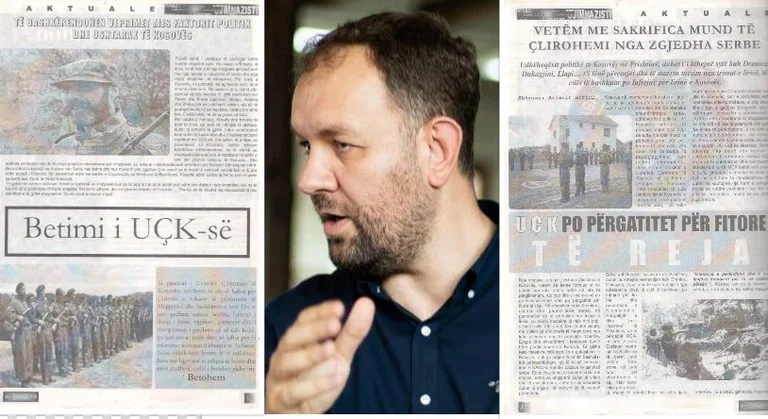
At that time, that is, during 1998 and thereafter, together with many friends, students at the “Xhevdet Doda” high school in Pristina, we had publicly expressed our support for the Kosovo Liberation Army. We did this through the school’s School Youth Organization, organizing roundtables with intellectuals, student leaders and well-known journalists, as well as by publishing articles in support of the KLA’s political and military orientation in our magazine “Gjimnazisti” and the student newspaper “Bota e Re”. We spoke openly at the roundtables, just as we published our articles under our full names, with no hesitation about concealing our identities.
“The world must understand that Kosovo under Serbia is not and cannot be a solution….”
Motivated by the testimony of James Rubin, a friend of Kosovo during difficult times and an American diplomat, I am recalling some quotations from these articles. As early as November 1998, in the article “Only through sacrifices can we free ourselves from the Serbian yoke”, at a time when Kosovo’s political leadership in Pristina was divided and sending no signals of support for the KLA, while the international community, represented by negotiator Hill and others, turned a blind eye to the Serbian offensive and tried to offer a solution for Kosovo within Serbia:
“Kosovo is currently at a major crossroads. While the freedom fighters face a devastating Serbian offensive, Kosovo’s political leaders remain divided, not realizing that one day the war could engulf every inch of Kosovo. They make irresponsible statements before the international community, denying the influence of the Kosovo Liberation Army in resolving the Kosovo issue. This disunity among Kosovo’s political entities is also exploited by the Serbian terrorist regime, which launched a major offensive against the people of Kosovo; but it was also exploited by the international community, which seemed to give Belgrade the green light to launch an offensive aimed at destroying the KLA and subjugating the Albanians, so that they would accept a supposedly temporary solution which, in fact, could be permanent – a new servitude.”
In the continuation of this article, precisely, with great faith that only continuing the war could free us from Serbia, I added:
“Serbia must understand that its offensive against the KLA has failed. Serbia may have temporarily taken control of some territories, but it has not destroyed the KLA and can never destroy it. The KLA is the people themselves.
The liberation war of the freedom fighters is entering an important phase, and we must understand once and for all that only its continuation and a more active policy can free us from Serbia.”
In the article, where I also wrote about the fall of the well-known commander Fehmi Lladrovci and his wife Xhevë Krasniqi-Lladrovci, calling for Kosovo’s political leaders to unite and coordinate their actions with the KLA, I emphasized that:
“We must all fight for the ideals of Fehmi, Xheva and the other freedom fighters who fell defending their homeland. Our leaders, too, must unite and coordinate their actions with the KLA, with the aim of achieving Kosovo’s independence. Only then will the international community see that Albanians are truly determined in their struggle for Kosovo’s definitive liberation. And then the West will not offer projects of subjugation to the Albanians, as did the one proposed by the American mediator for Kosovo, Christopher Hill.”
Prompted by Hill’s scandalous proposal, which at the time had also been published in the Albanian daily press, specifically in “Koha Ditore”, in this article of mine, published in November 1998, I emphasized that:
“The world must understand that Kosovo under Serbia is not and cannot be a solution. Every people has the right to decide its own fate, and so does the people of Kosovo. This is also provided for in the Charter of the United Nations, and Serbia, too, must understand that it can never hold on to Kosovo,” the article concludes.
“The people will not accept a new servitude”
In the same issue of “Gjimnazisti” at the end of 1998, together with my classmate Fiton Peja, also prompted by Hill’s proposal, we wrote a joint article titled “The people will not accept a new servitude”, in which, among other things, we wrote:
“After all this war, which is still continuing, after all these massacres, the West is offering the Albanians a frivolous ‘solution’, a new servitude. The best evidence of this is the American plans for Kosovo, Hill’s and Holbrooke’s.”
It is important to emphasize that we, as students during the liberation war, were deeply convinced that “without the direct participation of representatives of the KLA General Staff in negotiations, no agreement can be reached on Kosovo’s future status. The world, too, must finally understand that after Serbian aggression in Kosovo, independence for Kosovo is the fairest and most lasting solution to the Kosovo problem.”
In this respect, time proved us right. The democratic world, led by the United States of America, responded positively in support of Kosovo and our liberation war, focusing on the essential role of the Kosovo Liberation Army in reaching a lasting agreement to achieve Kosovo’s liberation.
This faith of ours, as a generation of Pristina high-school graduates in 1998-1999, that the US had to free itself from scandalous proposals of the Christopher Hill kind and take a more decisive role in supporting Kosovo’s freedom, was confirmed in the best possible way by James Rubin in The Hague, when, among other things, he said:
“We wanted to make sure that we were on the side of the angels, on the side of the good guys. And we didn’t want them to be victims. But they couldn’t be victims if they committed war crimes, nor would they be victims if they had an extremist Islamic outlook.”
Therefore, as in 1998, today, too, I say with conviction and faith that Kosovo was supported by the US on its path to liberation and statehood only because it waged a just war with a clear commitment to promoting the democratic values of Western civilization in this part of Europe as well. This history of Kosovo’s freedom cannot be rewritten.
P.S. Along with this opinion piece, I am now presenting two articles from 1998 published in support of the KLA and arguing against Christopher Hill’s proposal for a solution to the Kosovo issue within Serbia