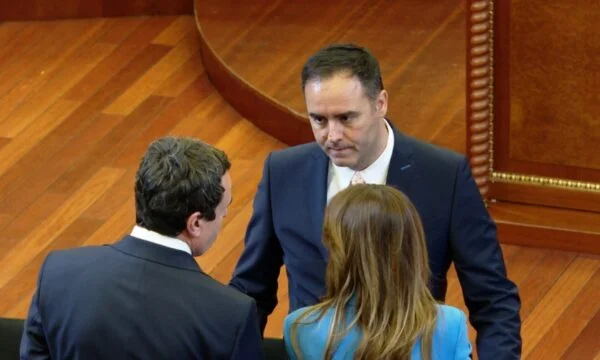
Glauk Konjufca, the philosopher who knows the weight of words. Unlike Dimal Basha, Albulena Haxhiu or Jusuf Gërvalla’s Girl, whose harsh words slip out as empty slogans, Konjufca knows that every word carries history and responsibility, which is why his sin is graver
Written by Baton Haxhiu
Glauk! Treason is a weighty word. You used this word loudly today at the VV rally.
Treason is the word nations use when describing the final moment of their survival. It is the word that the histories of peoples reserve for sold-out heroes, for kings who have handed over the keys to their cities, and for those who open the doors to the enemy at night.
It is not a word to use for a Constitutional Court that is doing its job. The irony is that by saying this word, you are not labeling the court, but shifting its shadow onto yourselves and the party you lead, you and Albin.
Glauk, as a student of philosophy, you know better than anyone that words have weight, that a word is not just a sound, but a concept that carries history and consequences.
The word “treason” is one of the great sins of political language, and it is usually left to those who understand neither its weight nor where it should be used.
The word “treason” suits Dimal Basha, Jusuf Gërvalla’s Girl, or Albulena Haxhiu, because they use language as a slogan, without knowing that every harsh word inflicts wounds on institutions. But when this word is used by someone who has studied philosophy, it is no longer ignorance, but a conscious choice. And that is a greater sin.
Because Kosovo’s Constitution is not an invention of Vetëvendosje, nor of the LDK, nor of any party of the moment. It is the legacy of the Ahtisaari Plan, conceived not as a pure act of sovereignty, but as a key to stability.
Ahtisaari and the authors of the Constitution knew well that the Albanian majority, emerging from the war, might be tempted to wield the force of numbers.
They knew just as well that Serbia would seek to intervene through the Serbian minority. To avoid both extremes, they created an architecture resembling a two-chamber parliament, as I said one night on “Presing” with Leo: one chamber is the governing majority, and the second is the Serbian minority with a security key. This was the compromise that gave Kosovo internationally recognized independence.
These keys were not put in place to give Belgrade power over Kosovo, but to prevent Belgrade from finding a pretext to bring its hands back here. And we are very fortunate to have such a Constitution, because it is the shield that makes Kosovo a multiethnic state in the legal order, not merely a multiethnic society in the social order.
This distinction is significant because we must be clear with ourselves: if we are a multiethnic state, then the Serb List and the court have the right to protect their role. If we are a multiethnic society, then they are a respected minority, but without the right to block. The Constitution has clearly chosen the first model.
Herein lies the second danger: when today’s government declares the word “treason” a curse against the court, it forgets that this word can turn back on the government itself. We have seen how easily alliances change, how quickly yesterday’s visits and words spoken in haste are forgotten.
What was permissible yesterday is declared forbidden today. And the word “treason,” in this game of mirrors, never remains only with the other side, because it comes back like a boomerang to the one who used it. (Remember how despicably you spoke about friends at a meeting, you and Albin, with President Ilir Meta at the time.)
Glauk, those who are afraid of Serbs today forget the simple reality that there are so few of them, and that they are so disrespected by everyone, that they have become more victims than a threat.
They are a small group, mostly elderly, a community that is naturally disappearing as a minority. And if history has a cold hand, biology is doing precisely what a part of Albanian society never wanted to do itself; biology, then, is dissolving a population that brought blame upon itself through its silence and complicity in the 1990s.
Therefore, do not do what you did not want done to you. Do not repeat the injustice you grew up with and suffered as a majority.
Because the responsibility for moving toward silent fascism, where a majority population closes its eyes and allows a minority to be oppressed, is a responsibility that could destroy the state itself.
It is not popular to say this, but it is true, and someone must say it, because whoever loses their sense of justice in the name of the majority risks losing the state itself.
In this dual architecture, KFOR is the international shield that physically protects Kosovo, while the Constitution is the internal shield that legally protects the Serbs.
One prevents the return of the Serbian army, the other prevents the exclusion that would give Serbia a pretext to intervene. Without one, the other cannot work either. This is our contract for survival as a state.
Therefore, when you call a Constitutional Court decision treason against the state, you risk doing precisely what you call treason, because your words overturn the constitutional order from within.
Because the word treason in the legal order is not a metaphor for press conferences. It is the most serious accusation known to criminal law. And when uttered against a court, it comes back like a boomerang and falls on those who use it, not those who hear it.
If you think the Constitution is wrong, then there is an institutional path: change the Constitution. Gather the votes, get the support of international partners, and write a new order.
But do not attach the word treason to an institution that exists to preserve this country’s stability. Because, to be honest, the word treason suits Vetëvendosje more, given its language and actions against the constitutional order, than the decisions the court makes.
You can do all of these things. You can declare war on the Constitutional Court, you can talk about treason, you can make the Constitution a hostage to the rhetoric of the day.
But you must take responsibility for the consequences. Because the word you direct at the court today may fall on your heads tomorrow. The word treason.