By: Ismail Syla
Don’t speak! Don’t whisper! Don’t make signs with your fingers! Don’t bring water bottles, etc.! Don’t carry a bag! These are the symbols of prohibitions, affixed to the lower part of the screens – monitors in the gallery of the Special Court building in The Hague. “Do not lean forward” is the warning written in three languages, Albanian, English and Serbian (do not bend forward), precisely below the bulletproof glass, through which court hearings can be followed, whose expressions have nuances that differ from one language to another. Translated word for word from English, it means hearing; from Serbian, main shaking; while in Albanian, court hearing.
In this gallery, you can listen to the proceedings in the courtroom through headphones in three languages. In Albanian, you hear the voices of interpreters who, from the way they pronounce words, are easily identified as being from Albania. In the past, these interpreters have caused some comical mix-ups. For example, when an Albanian witness said that we had traveled by car on “terun” (when the ground was not wet, that is, dry, dried out, without mud, mire or slush), the interpreter rendered it as “in the dark.” As soon as the prosecutor heard this word, she launched into questions about why you had traveled in the dark, opening a new chapter in the mystery surrounding the movements of KLA members. The witness was unable to understand the confusion and clarify that he had not said “terr” (darkness), but “terun”—that is, on ground or roads not wet from rain or melting snow.
At the beginning of this week, both in the morning and in the afternoon, I followed the hearings from the gallery of this court. Standing when the judicial panel enters is mandatory, including for visitors in the gallery, as it is whenever the judges leave the courtroom. As soon as the judges stand, the curtain automatically begins to descend, blocking the view into the courtroom. During the 10-minute break, visitors can move down one floor to the ground level, or leave the building during the half-hour break or the one-and-a-half-hour lunch break.
Those who spend all day in the gallery notice that the air conditioning is inadequate, as exhaustion and sleepiness come over you suddenly. Whether this is done deliberately or is a technical fault is unknown. When I mentioned this feeling to a female security guard, she politely said she would pass it on to her supervisor. The security guards change frequently. They do not hesitate to reprimand visitors and gallery-goers for certain actions: talking, smirking, or making any sign toward the people on trial.
When the judges enter the courtroom, the defendants also stand and, at that moment, look toward the gallery, which is not a violation. From a seated position in the gallery, you can see President Thaçi and Rexhep Selimi, as well as the members of the defense team, the whole time. From this position, however, you cannot see Kadri Veseli and Jakup Krasniqi, nor their defense teams, because the bulletproof glass is fogged and opaque. They can be seen only if you approach the glass, which is also “not permitted,” as the words on the strip say: “Do not lean forward.” Mr. Veseli and Mr. Krasniqi can be seen only if you stand, when seated in the row of chairs near the glass.
Since the raid on November 1, 2023, I have not visited President Thaçi again. Nor is he allowed to be called by phone. On March 13 of this year, he came to the University Clinical Center of Kosovo (QKUK) to visit his seriously ill father. It was a visit that made headlines. The citizens who happened to be in the courtyard in front of the internal medicine clinic at the time showed a high degree of civic spirit and maturity. They chanted Thaçi’s name and that of the KLA. There were no calls against the Hague team or against EULEX. In fact, one citizen said that we are here to express support for the president and the KLA. We will not take any wrong steps.
President Thaçi’s visit left a media footprint. It left behind the salute with his hand over his heart and the thumbs-up gesture—the OK sign, the royal gesture of salvation and the gladiator’s forgiveness. During this visit, I did not “rush” to QKUK, for the sole reason that I did not want to attract attention—not out of fear, but out of a code of respect for a man who had come to see his parent in a seriously deteriorated state of health.
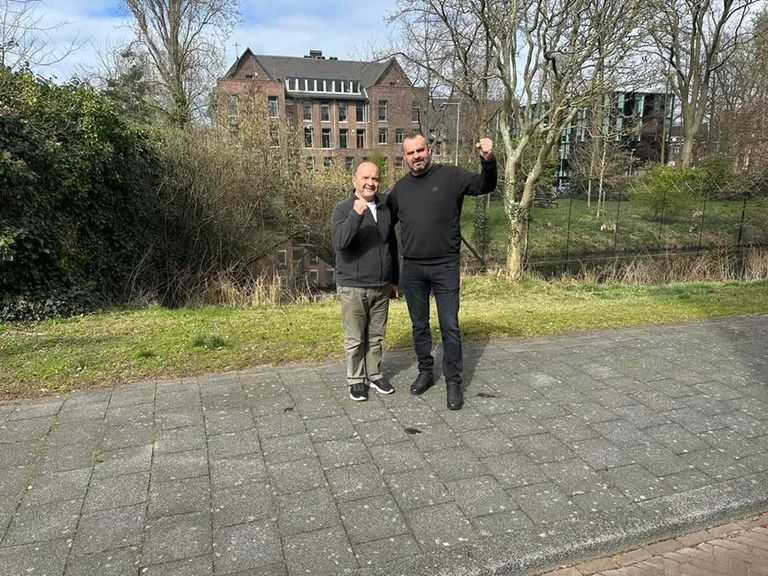
It was not long before the president’s father died. On March 21, the first day of spring, three days after the funeral, President Thaçi laid a wreath on his father’s grave. A new grave was opened that day for one of his cousins. Just as Thaçi finished paying his respects at his father’s grave, nearby cousins told him to stay strong. In response, he made a gesture, a sign. He raised his clenched fist. It was a fist with a particular meaning. Not a proletarian fist, not a fist of national unity, not a fist of political unification. It was a sign: “Yes, I am strong!” (At least, that is how I read the sign.)
With the prosecution’s large number of witnesses nearing its end, I decided to travel many kilometers to see President Thaçi up close. On Monday, March 24, the trial hearing opened at 9 o’clock. I greeted all the men being tried there, without a hand gesture or words, only with my eyes and a smile. Rexhep Selimi noticed me first. Through the bulletproof glass, I offered my condolences to President Hashim Thaçi—not with my hand or words, but only with my eyes.
This expression of condolence is the most unusual of all the condolences I have offered in my life. The prisoners in The Hague are losing their loved ones. Both of Kadri Veseli’s parents died while he was being held in The Hague prison. Jakup Krasniqi’s brother, much younger than him, died. Mr. Gucati’s father died. Nasim’s brother died. These men, who lost comrades even during wartime, are now losing relatives while imprisoned. A year ago, Xhavit Ferizi died, one of Hashim Thaçi’s most loyal collaborators.
All these deaths are taking on an added weight—that of imprisonment. May the president’s father’s death be the last that they have to face behind bars.