What are the real threats posed by combining the “verticalization of power” with religion in the Serbo-Russian doctrine of hybrid warfare?
Author: Dr. Gurakuç Kuçi – Senior Researcher at the “OCTOPUS” Institute for Hybrid Warfare Studies and professor at UNI College
Autocracies rarely invent new methods; they usually recycle those that have worked and adapt them to the circumstances of the moment. Two instruments are almost always activated when an authoritarian regime prepares for external action: the verticalization of power and the construction of myths of the “defender of civilization” type. Russia and Serbia are classic examples of this model. Both have established strong top-down control structures, while simultaneously promoting the narrative that their actions are carried out in the name of “Christianity” or the “defense of Europe.” This combination of extreme centralization and political mythology has served to mask expansionist ambitions and create a moral shield that justifies pressure, destabilization, or more sophisticated forms of hybrid warfare.
Vertical power as an autocratic mechanism
In political science, “vertical power” describes the hierarchical concentration of power from top to bottom, and Serbia, like Russia, has traditionally demonstrated complete institutional and social synchronization in its hegemonic policy toward Kosovo. Under Putin, Russia moved toward a deeply presidential model: the 2003 Duma elections, the dismissal of the government before the 2004 presidential election, and the abolition of direct elections for governors consolidated this course. Linz links authoritarianism with limited pluralism and centralized control. According to Levitsky and Way, “vertical power” simply explains the mechanics of this centralization. It dismantles institutional checks and balances and ensures one-way transmission of authority.
Russia and Serbia implement this model through the extreme concentration of decision-making: Putin expands presidential powers and control over governors, while Vučić builds dominance by capturing state institutions. According to Bieber, authoritarian regimes mask this control with democratic facades, election manipulation, a politicized judiciary, and subservient legislatures.
Recent developments in Serbia have shown that the country is now in the final stage of the complete verticalization of power and the consolidation of autocracy, despite powerful anti-Vučić protests.
To consolidate the verticalization of power, Serbia is implementing the complete centralization of the security sector. The army, police, and intelligence services are being brought under the President, including through legal reforms, while 89 million euros are planned for the BIA alone in 2026—an unusual increase, partly concealed under “confidential programs.” This comes at a time when the United States and its allies are calling for global de-escalation, while Serbia is moving in the opposite direction. Likewise, the new amendments to the Law on the Armed Forces are intended to place the Chief of the General Staff and officers under the President’s direct command, which is not currently the case. The model, however, is familiar: it is a return to Milošević’s playbook before the wars in Kosovo, Croatia, Bosnia and Herzegovina, and Slovenia. The verticalization of power never proceeds alone. It is accompanied by the narrative that justifies it.
The “defender” of Christianity and the neutralization of crimes
After centralizing every link in political power, Russia extended the same verticalization to the sacred sphere. In official Russian discourse, Moscow presents itself as the “defender of Orthodoxy and traditional values,” the last bastion against “Western degeneracy.” Aleksandr Dugin has placed this narrative in an almost mystical dimension: Russia as “the katechon,” the force that stops evil and preserves “true Christianity.” For him, the war in Ukraine is not merely a geopolitical conflict, but a sacred battle against the liberal world. This language has now become part of the Kremlin’s official line, and part of the Russian World strategy.
But in the Balkans, the game is more sophisticated: Russia and Serbia share the roles, but not the purpose. Russia is the “defender of Orthodoxy,” something linked to its historical and national identity. Serbia, meanwhile, takes on a broader role: it positions itself as the “defender of Christianity” and the “defender of Europe” from the Balkans. This gives Serbia a veneer that works better in the West, while at the same time opening a clear door for Russian hybrid influence. If Russia cannot present itself as the defender of Western Christianity, Serbia can. It has been marketed as such for centuries.
Precisely for this reason, Dugin treats Serbia as a figure of almost mythical importance. He sees it as the bridge that makes Russian ideology acceptable in Europe. Serbia creates the facade; Russia supplies it with all the ideological thinking and strategic substance. This is the symbiosis: one has the symbolism, the other the doctrine.
The Serbian myth of “neutrality” and the minor, staged clashes with Moscow serve only to create the appearance of an independent actor. In practice, Serbia plays the role of a proxy that uses religious language to justify policies aligned with Russia.
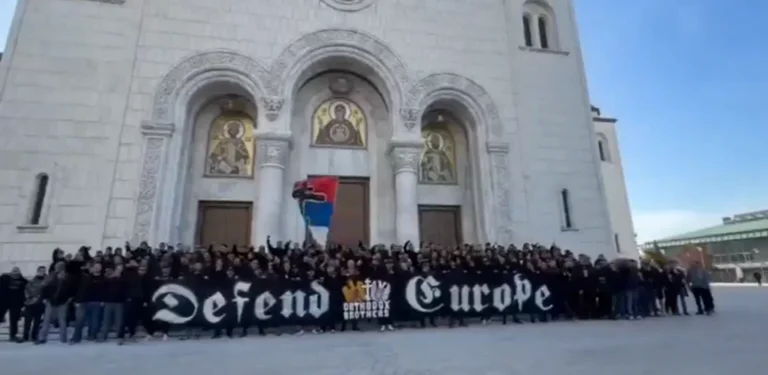
The revival of the sacred element is visible. In Serbia and abroad, radical groups are reviving the same language Milošević used before the wars: Serbia as the shield of Europe and Christianity. Today, this is openly displayed at rallies, concerts, football matches, in graffiti, and in activities by extremist groups from Serbia, Romania, and other countries.
A clear example: Romanian extremists in Belgrade with a banner calling Ratko Mladić “the European hero who brought the Muslims down to zero.” This is not merely a provocation—it is the normalization of crime under the guise of civilization.
The same narrative appears among Romanian fans at the football match with Bosnia, where Serbia is presented as the “defender of Europe.” Within Serbia, at pro-Vučić protests, radical groups praise war criminals, sing against Muslims, and sell Serbia as a fortress of Christianity. At the same time, Belgrade has become a regular supplier of propaganda campaigns in the region, especially against Kosovo and Albanians, inciting Kosovo’s neighboring peoples against Albanians and the state of Kosovo.
In this climate, the effects also extend inside Kosovo. Here too, voices are emerging that recycle Islamophobia, making their way unnaturally into certain groups and media outlets.
Through its propaganda efforts presenting itself as the “defender of Christianity,” Serbia is dominating the narrative of neutralizing the crimes committed against Bosniaks and Albanians.
Current security dynamics as an opportunity for Serbia to gain an advantage
Today’s geopolitical circumstances seem to swing between two extremes. One moment there is talk of peace and de-escalation; the next, fears emerge that tensions could take an entirely different turn. A few weeks ago, European Commissioner for Defense Andrius Kubilius said that German intelligence had information about discussions within the Kremlin concerning a possible Russian scenario against NATO.
Meanwhile, NATO Secretary General Mark Rutte, speaking at a meeting with NATO foreign ministers in Brussels, warned that Russia is “working closely” with China, North Korea, and Iran “to disrupt our societies and destroy global rules,” and is “preparing for long-term confrontation.”
Also, during the special hearing “Flashpoint: A Path Toward Stability in the Western Balkans” before the House Foreign Affairs Committee, Subcommittee on Europe Chairman Keith Self warned that, in addition to Russian aggression against Ukraine, the Western Balkans remains the most unstable region in Europe. According to him, Albania, Montenegro, and Macedonia would be directly in the line of fire in a renewed conflict, while Kosovo remains particularly exposed because it is not a NATO member.
Germany, for its part, has centralized military command and prepared the “OPKAN DEU” plan, a voluminous document that envisages rapid mobilization and the use of civilian networks for military purposes in the event of a crisis. Baltic and Nordic reports for 2024–2025 also warn that Russia is restructuring its forces to have the capacity for both conventional conflict and hybrid forms of warfare, should the global situation deteriorate.
Russia has denied that it is prepared to attack any NATO or European country outside Ukraine. However, if peace plans do not go well, that does not guarantee the situation cannot escalate.
Conclusions and strategic assessments
As long as Serbia’s engagement in verticalization and propaganda remains at a high level, and cooperation between Serbian intelligence and Russian intelligence—and possibly Chinese intelligence as well—is at the level of allies, this indicates that Serbia’s plans, based on the knowledge and preparations it shares with allied intelligence services, go beyond the official reality, and that scenarios are being prepared which are not openly articulated.
Serbia’s verticalization of power enables it to have an architecture for rapid action without delays or accountability. Meanwhile, through sacred propaganda, it mobilizes the masses and keeps public opinion ready to justify any move by Serbia, presenting it as a state waging a “crusade.”
A second tool for influencing international opinion, especially Western opinion, is provided by the high levels of propaganda disseminated through audiovisual and digital media, where propaganda via these channels is now almost uncontrollable. This second tool enables Serbia, and consequently Russia, to legitimize their actions as an anti-Islam campaign. The aim is to arouse religious sympathy, and for that religious sympathy among pro-Western groups to put pressure on their governments not to respond to Russian-Serbian actions.
In principle, we must understand that this has nothing to do with genuine religious issues; it is exploitation for the purposes of division and dominance.
The current phase is now one of normalizing the crisis, creating a state in which tension is treated as the norm rather than a deviation, while the future remains uncertain precisely because of these models, designed to be unpredictable and usable at any moment of opportunism.