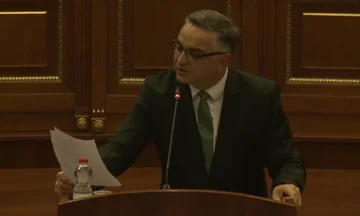
By: Hisen Berisha
The case of Kosovo Prime Minister Albin Kurti’s involvement as a witness in the prosecutorial file related to the procedures for purchasing and supplying state reserves represents one of the most unusual cases of selective treatment of criminal responsibility in the history of Kosovo’s new justice system.
The Government’s own official documents and administrative processes dated 23–26 February 2022 demonstrate direct executive interference in public procurement procedures, through the unlawful exclusion of competitive procedures for the supply of goods for state reserves, under the classification of the contract as “secret.”
From a legal perspective, this act constitutes clear elements of abuse of official position or authority under the Criminal Code of the Republic of Kosovo, with direct consequences for the undermining of the principles of fair, equal and transparent public procurement set out in Articles 1 and 3 of Law No. 04/L-042. The government decision signed by Prime Minister Kurti and initiated by the Ministry of Industry, Entrepreneurship and Trade constitutes a direct administrative act with legal and financial effect, for which criminal and political responsibility rests with the signatory and final approving authority of the decision – acta non verba / actions, not words – determine legal responsibility.
In this context, the fact that the Special Prosecution has summoned the Prime Minister only as a witness and not as the principal suspect represents a serious deviation from the principle of hierarchical criminal responsibility. The Criminal Procedure Code stipulates that responsibility for unlawful actions in an administrative process with financial effects cannot be confined to executing subordinates, but extends to the political decision-maker – respondeat superior / the superior is responsible – for the actions of their subordinates when they have ordered or tolerated the violation.
Therefore, the Special Prosecution of the Republic of Kosovo should be subject to public and institutional scrutiny over the suspicion surrounding the selective, delayed and politically motivated nature of its actions, as in the case of the removal of investigators in the state reserves case, without any pacta juridica regarding their conduct. Furthermore, the SP’s conduct in relation to cases directly involving Prime Minister Albin Kurti has created the perception that this prosecution is acting not to defend the law, but to defend those in power.
Sending Kurti a summons on the eve of national elections, used as an instrument to mobilize party militancy through the old victimization narrative; not escorting him after he refused to comply with the prosecutorial order to appear; and subsequently summoning him again as a witness, although hierarchically he is subject to criminal responsibility, constitute a serious deviation from the principles of justice and criminal hierarchy.
These actions not only compromise the integrity of the Special Prosecution, but also raise reasonable suspicions that it has become an instrument for covering up causes involving crimes linked to the Kurti government – fiat justitia, ruat caelum / let justice be done, though the heavens fall.
Moreover, the decision dated 26.02.2022 (No. 01/65), published in the Official Gazette, was preceded by a documented chain of electronic communications between officials of the MINT and the Prime Minister’s Cabinet (emails dated 25.02.2022), demonstrating full coordination and political approval for circumventing legal procurement procedures.
This action rules out the possibility of “administrative ignorance” and implies full intent (dolus directus) in signing a decision with harmful consequences for the state budget – ignorantia legis non excusat / ignorance of the law does not excuse responsibility.
If this matter were handled according to the standards of international criminal practice and the principle ubi culpa, ibi poena (where there is guilt, there is punishment), then treating Mr. Kurti as a witness would be impossible.
In this specific case, instead of upholding the Principle of Legality, the Special Prosecution has created a dangerous precedent of functional immunity for the executive branch, turning the criminal justice instrument into a tool for political justification – lex dura sed lex / the law is harsh, but it is the law.
The reasonable suspicion raised in public opinion that the Prosecution is serving the political cause of Kurti and the Vetëvendosje Movement is no longer an assumption, but an indication supported by the official documentation in prosecutorial file No. 2023:0038541 itself, where the list of evidence includes government acts and correspondence bearing the signatures of political signatories.
From a doctrinal perspective, this institutional conduct corresponds to the three classic forms of participation in the commission of a criminal offense, recognized in Roman law and modern European law:
– dare (giving), issuing an order or approving an act;
– facere (acting), signing or executing the decision;
– praestare (facilitating or tolerating the violation), institutional inaction to prevent it – qui facit per alium, facit per se / whoever acts through another acts themselves.
In this case, Kurti fulfills all three forms, and consequently, his classification as a witness rather than a suspect is legally unjustifiable and politically motivated.
Ultimately, this case is not merely a matter of criminal-law interpretation, but a test of the seriousness of the justice system in relation to political power.
The Special Prosecution’s silence, delays and procedural deviations undermine public confidence in the law and risk turning criminal responsibility into a political privilege.
If justice is incapable of investigating, summoning and holding even the prime minister accountable for acts with financial and administrative effects, then Kosovo risks returning to the model of impunity it inherited from the darkest periods of its institutional transition – summum ius, summa iniuria / the extreme application of the law without justice is the greatest injustice.