By Floresha Dado
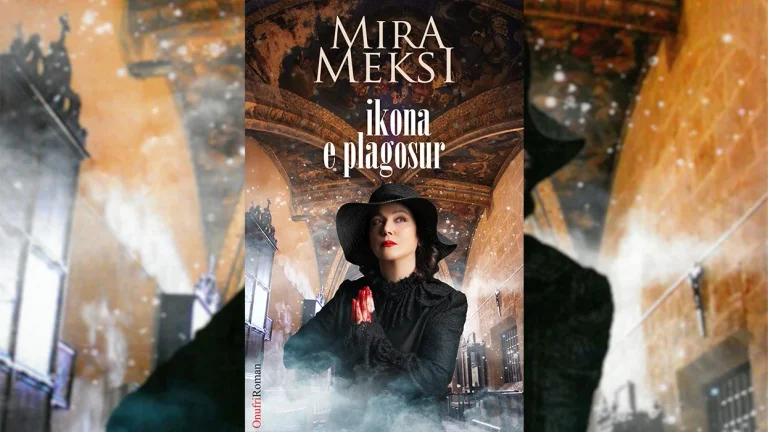
Directly or indirectly, history has often been a stimulus for the creative work of many authors. In some of Mira Meksi’s novels, history enters with direct authority, serving both as inspiration and as a provocation to grasp the meaning of the work. Of course, incorporated into a specific structure of literature, it carries within itself a convention, which is taken up again to serve an ideological aim… It is known that when events belong to a historical background they are not reproduced in their original course; they are presented anew, with the author aware that they may become “debatable” in terms of their authenticity, and questionable in relation to reality. Theory has established that an event is deemed “historical” when it is tangible, perceptible in the process of its narration. The new novel “The Wounded Icon,” which spans two centuries—the present one and the sixteenth century—artistically shapes an extraordinary subject, one never before treated in our literature, and achieves this essential specificity. Historical facts and iconic figures from our history, such as Donika Kastrioti… and events involving Skanderbeg’s descendants… are wonderfully interwoven in it.

Floresha Dado
How did this artistic inspiration come about? A finding in a scholarly study concerning the existence of a Byzantine icon, owned by Donika Kastrioti and kept at the Royal Monastery of the Holy Trinity in Valencia, Spain, stirred the mind of prose writer Mira Meksi and drew her into a world that was both complicated and magical, as well as moving. After countless readings of documents and studies by foreign and Albanian authors, an extraordinary artistic edifice gradually took shape in her imagination. It carries within it historical facts about phenomena not previously treated in our literature, and ideas of particular importance for the identity and greatness of the Kastrioti family. Her passion for exploring the history of this Kastrioti icon would spur her imagination to illuminate the little-known figure of Donika, the wife of the national hero, and to go even further in an “artistic search” for the place where Skanderbeg’s remains were reburied. Thus was born the novel “The Wounded Icon,” a work that demonstrates a new level in Mira Meksi’s creative process.
A “Trap” for the Historian
How does the literary system differ from, and coincide with, historicity (something very important to understanding the essence of the novel)? Is this simply a historical novel? And, more fundamentally, is the relationship between historical truth and its treatment in this literary work problematic? These are questions that involve, above all, understanding and distinguishing the nature of history and literature, and the relationship between them. The issue would concern our historian first and foremost.
History is not only the history of concrete reality; it is also the history of ideas, feelings, dreams… The distinction between history and literature narrows and becomes filled in when our interpretation sees the work not as a reflection of a purely historical process, but rather as the discovery of history in the course of literary poetics. This means that understanding the historical character of a work requires perceiving it as a confirmation of the literary system, which also means that its historical character should not be seen merely in the work’s faithful correspondence to historical reality. According to the renowned scholar Todorov, history is a convention, it does not exist at the level of events in themselves…. History is an abstraction; although it is always perceived and told by someone, it does not exist “in itself.” This thesis draws attention to a deeper conception of the meaning of history, when it is brought anew into a literary work. As a system created from symbols, the work is understood through the totality of knowledge of a history, but by requiring a different way of reading. In assessing this novel too, invention is an original intermediary between fact and counter-reflection. Theorists of antiquity, with extraordinary intuition, established the distinction between history and literary discourse (I would go further: even when this discourse is connected to history). According to Cicero, the criterion of judgment in history is truth, while in poetry it is pleasure.
The history of the novel “The Wounded Icon” should be judged more as a story that our identity-based culture tells about itself, and not simply and solely as a collection of verifiable facts. It is the author’s specific relationship with one of the important threads of our history. This is not merely a relationship of identification, but a sublime purpose: for the reader to experience the past emotionally…
The question naturally arises as to how the construction of this novel’s literary system coincides with its historicity, and where it differs. That is, how would the historical dimension of “The Wounded Icon” be perceived? If we were to return to Shklovsky’s view, according to which literature “renews our understanding of life and experience”… we understand how important the confrontation between “historical fact” and the author’s “subjective” act of reflection is in this work. The first concerns real circumstances and context, while the second is an ideal object (the author’s perception) that can be reidentified by different readers. Value arises when artistic discourse succeeds in establishing an equivalence between the historical and subjective experience. I believe the fundamental axis that clarifies this relationship in M. Meksi’s novel is the acceptance that what is real and historical is what is felt, what brings back a time and not merely what exists.
Artistic Structure—Interconnection of Three Intriguing Planes
A. The search for the Icon protected by the Lady of the Kastriotis, an important keeper of relics…
B. The personality and virtues of Donika Kastrioti, little known; her movements between Valencia and Naples, the history of the location of her tomb… Gjergj Kastrioti’s descendants…
C. The place where Skanderbeg’s remains were reburied, in the Tower of Arbër, near the monastery of Hilandar on Mount Athos.
This complex, intriguing structure encompasses cities in four countries: Vlora, Naples,
Valencia, Mount Athos.
Is this an architectural metaphor…?
A. The Search for and Mystery of the Kastrioti Icon
The key to the entire structure of meaning!
Information about the existence of the unknown sacred icon, zealously guarded by Donika Kastrioti, becomes the key that opens a difficult journey, a remarkable passion for artistic research. Tracking down the icon, called Our Lady of the Refuge of Sinners, at the Royal Monastery of the Holy Trinity in Valencia, brings together and develops artistically through fact and creative imagination, issues that are both interesting and important to the history of the sixteenth century. The marks of knife damage to this icon, inflicted by Ottoman or Orthodox inquisitors, in pursuit of a great secret it might have concealed within its inner layer, prompted the author to call it “The Wounded Icon.” “…I placed the palm of my hand on the surface of the icon. What I felt and experienced in that fragment of time laid the foundations of the edifice of the story I would tell later,” the author writes in the preface at the beginning of the novel. p. XI. This particular intuition about the icon’s essence, which appears as a very important symbol in several of the author’s works, propels her imagination toward the conviction that there must be a secret inside it. “The existence of the Kastrioti Icon could be linked to an encoded message, a symbol, the hidden sacred.” This inner intuition, also connected with the artistic rediscovery of other phenomena, has shaped the difficult, courageous journey of this prose writer, who never stops in her imaginative searches and discoveries. Arber’s assertion—he is a fellow traveler in this search—that “this icon, like the others that represent the highest art of iconography, serves, through its visible image, to lead its admirer into the invisible, the transcendent, the unattainable… In other words, to lead the person who knows how to read the icon to the message or sign it conceals, or to decipher the code embodied in it” (p. 23) ignites the passion for searching for this mystical object, in which, according to Nora, another fellow traveler, “the message, symbol, or sacred element, but also a document or something highly important and material, may be hidden in its body” (p. 24). But this central impetus for further research brings together information about the icon’s whereabouts and its journey to Naples and Valencia, Spain; it complicates the circumstances of the icon’s persecution, brings to light real sources about the Palatine church where the icon is said to have been… and everything is filled and brought to life by the narrator’s imagination. Drawing on the fact that “in the time of the European Renaissance religious objects were relic repositories” and that “Madama Donica Castriota was very attached to the icon in question and kept it as a precious treasure,” and that “The Wounded Icon must date from after Skanderbeg’s death” (pp. 126, 127), the author develops, through the actions of her two seekers, a very interesting and provocative narrative line, one that also challenges scholarly awareness. The information that “in a manuscript by Frater Geronimo Sanchez I found evidence proving that Donika Kastrioti’s Icon was miraculous and that, in the sixteenth century, a Brotherhood of the Devout of the Icon had been established” (p. 217), the discoveries in the Valencia monastery’s archives, the historical facts about the close relationship between Donika Kastrioti and Queen Juana III of Naples, the discovery of the Icon’s miniature, and so on, lead the passionate pair, Arber and Nora, after this accidental discovery, to find and touch the Icon, which is closely connected with the figure of the great Lady of Arbër as well as the location of her remains in Venice. On the other hand, the pursuit of the danger of the Icon’s secret being stolen, a secret that guards an important mystery, creates a relationship in which, at first glance, it is difficult to distinguish truth from artistic invention. Literature gives historical and documentary facts vitality, color, and emotion. The reasoning of the two searchers, their relationship with the facts they uncover and with their surroundings, the description of the Lady of Arbër’s existence and movements, and the interweaving of historical facts with the author’s creative imagination create a distinctive relationship with the reader. The narrator’s imagination keeps the reader’s sensibility suspended when “The Icon’s secret had appeared before their eyes in all its grandeur, leaving them speechless. Nora touched the first of the sheets of parchment, one on top of another, which began at the bottom of the icon… There was their greatest dream: a map. They could not believe their eyes…” The Icon’s radiograph deepens our understanding of the extraordinary nature and interior of this relic-bearing object, revealing the great secret: the map of the Tower of Arbër, at the Hilandar Monastery on Mount Athos, where the Kastrioti coat of arms can be discerned with a magnifying glass on the summit of a small church… The author’s exhilarating imagination, which in fact has a historical basis (clearly explained during the narrative), provokes, for the first time, recognition of the place where the remains of our national hero were reburied. Experienced artistically, as a major discovery for Albanian history, the novel constructs an approach to the history of the Kastriotis that is both interesting and provocative. Nevertheless, the narrative becomes “believable” to the reader because it is spurred on and built upon research into documents, specialized publications, data, and the serious observations of two characters passionate about uncovering the truth hidden within this icon (which is still at the Royal Monastery of Valencia).
Mira Meksi is distinguished by her ability to see value in our history, both ancient and recent, by her approach to every period, at once realistic and refined, by the continuity she seeks to construct between them, and by the value and weight she attributes to the Albanian language since antiquity. The studies of the searching character Arber’s great-grandfather, his ancestor Isaiah, the scholarly theses, the boxes of old historical documents, manuscripts, and rolls of parchment preserved in the family home in Vlora… all contribute, among other things, to an extraordinary narrative about this area’s cultural tradition, about which nothing has been written before.
Closely linked to this fundamental axis are the two other axes:
B. Donika Kastrioti and Her Descendants, Between Document and Fiction
Is the character’s perception an emotional plane? Why does it affect our experience? This question becomes even more complicated when the character emerges from history, as is the case with Donika Kastrioti. As the supporting axis of the entire narrative, she presents the reader—and especially the historian—with the dilemma of establishing a dividing line between real existence and her shaping as a character. At different levels of the narration, these two relationships sometimes merge and sometimes alternate. The distance between this character and real events constitutes the true challenge. The novel makes us believe that we have now seen the great Lady Donika, who, though little known in our knowledge, realizes herself within the structure of the novel. Of course, the process of shaping, reconstructing, and characterizing her is not easy, because it places the narrator before the naive “judgment” of what is true and how far invention goes. But for the reader this is not fundamentally important; the reader is eager to know the essence of this historical figure, connected with the great hero of our national history, because through the mastery of artistic construction this character carries the historical reality of the Kastrioti family. Donika’s essential traits are gentleness, refinement, wisdom, spiritual devotion to the Almighty, noble loyalty to her husband’s mission and the fate of Arbër, and resignation to the fate of her children… Within her lies a synthesis of truth and artistic invention, because it is known that the shaping of characters ranges from ordinary and acceptable traits to unnatural ones…
Donika’s figure takes on astonishing meaning as we read, through the way the narrative unfolds… The work combines magically the way the text reveals her figure with the reader’s perception, which pays particular attention to this historical figure. The relationship is such that this figure is not merely characterized, but experienced, an extraordinary effect in the reader’s imagination. This means that the character Donika is not simply “seen,” but completed and illuminated. That is to say, through a system of devices, details, and the narrator’s points of view, we imagine her physical and moral image and become captive to the “illusion of reality” surrounding her. The reader has an inward desire to see in Donika Kastrioti the embodiment of a sacred historical ideal. This makes the magic of this figure, and our sympathy for her, greater than what documentary knowledge gives us. (M. Meksi is known for her passion for bringing women—illustrious historical figures—into literature, such as Teuta of Illyria. Her achievement lies in shaping figures from the distant past who are little or not at all known, enriching readers with images of them.) In relation to Donika’s figure, the distinction between the process of “seeing her” and the process of “perceiving her” is specific. Her portrait emerges like a sculpture carved from a combination of light, noble movements, thoughts, and spiritual sensitivity. I believe that in this novel the phenomenon of perception takes precedence, encompassing aspects of inner knowledge, such as Donika’s thoughts and judgments, and thus relating more to her inner world. This process encompasses movement, combinations, different choices, a queen’s ability to handle situations, and an admirable balance between emotional experience and rational demeanor… “With a dark silk scarf falling from her hair to the ground, Donika Kastrioti knelt before the altar in the single nave of Santa Chiara. She lit a candle and, her eyes fixed on the light of Jesus Christ, prayed for her bloodied and enslaved country; she prayed for her Albanians, who had taken to the roads of the world, persecuted by the Ottomans; she prayed for her family, for her son, who fought the Aragonese king’s wars with his mind set on Arbëria, and for his family, together with her two grandsons; she also prayed for the remains of Gjergj Kastrioti.” p. 60. And then: “The moon-colored silk scarf on her head concealed the woman’s heavy hair, which covered her shoulders and fell to her waist. The first frost of an early winter appeared here and there among the chestnut locks that escaped the scarf. A sunbeam glinted across her white face at that moment, and Gjon thought he saw the Madonna herself” (p. 86).
Ways of conceiving a character may belong to several planes: the background against which the character is projected, the role it plays in the action, its manner of conduct, its identity in a social situation or psychological aspect, and its connection to a historical milieu, among others. In the novel “The Wounded Icon”, Donika Kastrioti’s figure is illuminated a little by each of these, through the intertwining of inner concerns and outward attitudes, noble silence and the guarding of the Kastrioti Icon’s secret, her inner relationship with the fate of Arbër, to which she hopes to return one day, and the relationships she builds with her son and grandson. Above all, she is shaped by the historical attitudes toward her of the kings and queens of Naples, distinguished Neapolitan noble families, and nuns of the famous monastery in Valencia; by her reputation beyond the borders of Arbër, Naples, and Valencia; and by the cultural level she inherited from her family, her education, and the broad culture she acquired under the care of her father, Gjergj Arianit Komneni. The shaping of this figure on these planes constitutes some of the most magical passages in the author’s descriptions and a moving rediscovery of Donika Kastrioti’s personality. In the modesty of her portrayal (the author’s profound point of view), Donika continually draws closer to the reader’s imagination, radiating wisdom, devotion, and nobility. Did we know this historical figure in this way? Perhaps the greatness of her husband, our national hero, left this great Lady somewhat in the shadows, though she descended from one of the most important noble families in sixteenth-century Albania. Literature completes historical knowledge; in a sense, it expands the boundaries of perception, which, due to its own specificity, history conveys sparingly. The reader’s encounter with this character, although historical, is primarily emotional, a magical discovery that spiritually enriches every reader.
The novel also arouses curiosity with the few details it offers about the life of the younger Gjon Kastrioti: in the Albanian and personal spheres, in the drama of sacrificing love in a marriage of alliance with the daughter of King Ferrante I, and in the “fading” of this figure after the death of his son, Alfonso, at the age of 15. Among the most interesting narrative lines is Donika’s relationship with her grandson Alfonso, whose tombstone M. Meksi herself discovered in the small church at the Royal Monastery of the Holy Trinity in Valencia (there are actual photographs taken by her). This is where the much-sought-after Icon of the Virgin of the Refuge of Sinners, dating from 1502, is located. The two storylines, concerning her son and grandson, lend the novel color and a lyrical voice, clothing history in relationships of human sensitivity. Although the historical aspect is faint, the relationships between the two characters, in their fictional plane, serve to complete the gentler human side of Donika Kastrioti. The use of artistic invention (love letters, conversations with their devoted mother, etc.) gives the work life and light, and naturally places it on the throne of artistic literature.
In shaping her characters, M. Meksi uses description with rare skill; in a way, it seems to take its own dignified place among the gallery of characters, historical or invented. The astonishing descriptions of settings in Naples and Valencia, of the architecture of churches and monasteries, of the colors of nature that give the characters’ feelings a particular intensity, or foreshadow a tragic end, or metaphorically anticipate and convey dramatic moments… (the burning of the Tower of Arbër on Athos…) are among the great strengths of her storytelling. It seems that in this novel, pictorial inspiration has reached its highest level across all her prose (surpassing even the novel “The Curse of the Priestesses of Illyria”).
C. “The Discovery” at the Hilandar Monastery on Mount Athos
This is the culmination of the mission to discover the Icon’s secret! The searches in Valencia and the manuscript of Reposh Kastrioti redirect the narrative toward the investigations on Mount Athos (actually conducted by the author’s son…). “That blessed icon had been made on Mount Athos… at the Hilandar Monastery,” the great Lady had partially revealed the Icon’s secret to her grandson. Documents (Acts) proving that Skanderbeg’s father, following the example of princes who had completed their historical mission, bought “in 1428 the Tower of St. George (later called the Tower of Arbër), under the jurisdiction of the Hilandar Monastery, together with the vineyard, olive trees, and surrounding lands with usufruct rights, as well as four adelphates, for himself and his four sons, paying 80 florins”, clarify the idea that the great secret may have been located in that area of the monastery, bought by Gjon Kastrioti for himself and his children (the graves of Gjon Kastrioti and Reposh are there). This entire narrative line is built on a combination of fact, real observation, and creative imagination, where, behind the “facilities” arranged at the monastery to continue the search, lie secret efforts to prevent the discovery of the great secret, guarded for centuries. The map found inside the Icon leads the character to the church of the Tower of Arbër, where Skanderbeg’s remains may have been reburied, protected from Ottoman vandalism… After every episode, every unexpected turn on the way to this church, loyalty intertwines with betrayal, truth with what is desired, and, above all, an extraordinary passion to discover the great historical truth that has remained unresolved for five centuries. It is a shocking key that has been kept hidden. “Which Serbian scholar or historian, or whoever, who has written about Hilandar, has mentioned Skanderbeg’s grave? No one. Why? Because it is very important to us, to our nation; it is our historical being, our identity…” (p. 335), the searching character asserts. The novel contains facts and fiction, great drama, suspense, mystery, fantasy, emotion… The tragic fate of the burning of the Tower of Arbër, conventionally linked to Donika Kastrioti’s dream in which, while waiting for Skanderbeg’s remains to be brought to her, she hallucinated that Ljesh was burning, artistically creates a metaphor for the centuries-long efforts to conceal the reburial of our national hero’s remains. But the author reopens the mystery of the secret: the remains must not have burned, because the imagination continues: “It was Cyril. What he said struck them like lightning from a clear sky—not to kill, but to clarify the world with the purifying fire of divinity: ‘The remains of Gjergj Kastrioti have not been in the church of the Tower of Arbër, beside his father, Gjon Kastrioti, for years. They are in Stefan Nemanja’s sarcophagus at Hilandar.’” (p. 351)
The mystery returns! An artistic illusion, or a shocking truth? Mira weaves the intrigue in such a way that everything remains open: an unfinished search, an artistic provocation concerning the truth history conceals, a rekindling of the passion to seek…
The Novel “Bets” with the Reader, A Model for Reading History
It is known that literature is a code that conveys new meanings, a new human universe through which knowledge of realities is transmitted… It is an experience of the writer’s efforts, through a specific language, not to convey this knowledge and meaning as a direct copy of real events… In this respect, the novel “The Wounded Icon” may provoke discussion about what kind of meaning underlies the entire edifice in which historical characters come to life. The question it poses to the reader is: in what way is artistic narration different from the characters and their historical actions? Certainly, in a literary work real events cannot speak for themselves, nor can they be conceived as narratives telling their own history, because that would give us a historical text. In this novel the reader will understand that it is not only history as narrated in some of its limited aspects, but also the plane behind the narration, the truth of the characters’ motives and behavior, as they move between reality and artistic invention. What gives the work value is its success in creating a union between naturalistic illusion and literary illusion. Therefore, this novel should be understood as an image containing the complexity of the author’s ideas, as a narration that is not merely a succession of events or a horizontal extension, but a vertical penetration into the depths, which would reveal the essence of its value. From this perspective, the work is an act of faith in what constitutes its essence. In a sense, the prose writer’s invention becomes reception in the reader, through the illusion that gives life to every episode… We can also see it as a test of the author and reader, faced with an emotional expectation full of dilemmas.
What will attract the reader more: historical facts, or artistic invention?
The novel is a harmonious fusion of two discourses: historical discourse, which is referential in character, and literary discourse, which takes shape through metaphors and other self-reflective figures. By fusing these two discourses, the author has sought to achieve a balance between invention and truth, and an inclination to give invention meaning. At the same time, we know that artistic invention appears as a combination of truth and its violation, but, nevertheless, we enter the illusion of a real world that moves us with its artistic intrigues. An intuition and interweaving of historical knowledge with its meaning! Here critics may discuss whether the fictional nature of the novel has caused reality to lose its value as a point of reference.
How important is the accuracy of the relationship between truth and invention to the reader? Should one approach the novel as a realist work? In philosophy, the realist conception is based on the independent existence of the world of objects, on belief in truth as communication between language and the world, and on the conviction that there is only one true description of the world. In literary theory, realism refers to the capacity of signs and images to convincingly and carefully reflect reality. But it is known that this concept was further complicated by modernist and later postmodernist literature, which shook the realist principle of creation. They confirmed the shift from the objective representation of reality to an individual perspective on reality. According to L. Hutcheon, “at a formal level, the novel holds the agreement between history and fiction in tension, bringing to the foreground the conflict between truth and invention, facts and beliefs, truth and illusion…”
It is known that the Albanian novel, including M. Meksi’s, has renewed the forms through which reality is recreated. The novel “The Wounded Icon” reminds us that what is real in history is not part of literature’s real content. In it, history becomes a discursive construction that brings fiction to life.
The novel may also prompt the reader to ask: what is in the foreground, history or the author’s reflection? Although Mira knows many facts, archival documents, and scholarly studies, I believe it is emotional-imaginative reflection that predominates. As the theorist Adorno stated: “Art is the image of reality.” The novel “The Wounded Icon” should also be read as an image of one thread of sixteenth-century history.
The Movements of the Soul
Literature can enchant us with the possibilities of the soul’s movement, beyond reason and human passions… In this respect, the description of facts and actions, the narration of actions and events, also constitutes an instinctive observation of behavior and states of mind. The novel is like this, even when it offers the assured image of knowledge, of understanding. The development of characters and the succession of scenes and events depend on this instinctive activity, combined with the narrator’s awareness. Therefore, we see the problem of “reconstructing history,” as authorial consciousness on the one hand, and the author’s emotional act on the other, as developing simultaneously; this makes M. Meksi’s novel an effect that is experienced.
Animating reality with dreams, hallucinatory moments, and fantasy that creates “visible” visions… is valuable because it achieves an understanding between truth and invention… Dreams come as warnings of tragic fates… In the work, a process unfolds in which historical discourse, interwoven with artistic discourse, gives expression to the author’s desire, frees her spirit and inner instincts, and creates a “deception” about real events or characters. In the words the character addresses to his fellow traveler Nora, it seems as though the author M. Meksi is speaking to herself: “Everything you have read takes material form in visions, dreams, states of an excited brain…” (p. 45).
The “real” images that the characters see when their minds are inflamed (Nora, Arber, Donika, …), Nora’s hallucinations—“I have traveled through time”—the scenes of “seeing” a castle on fire, the mysterious materialization of the “sight” of hands bloodied by the rope of a burning ship, the vision that envelops Donika Kastrioti, and so on, are scenes in which hallucination becomes real, believable, and the boundaries between history and the characters’ present merge. And this expresses the spiritual experience of Arbër’s fate throughout its history. In the metaphysical view, the character’s soul passes through many periods of time, as the distinction between body and soul transcends real-world imagination. Philosophically, the novel seeks to affirm that the eternal appears now, then, and always, and that the human mind cannot grasp the mystery of historical life. Through the character Arber, the novel asserts: “Let us not trouble ourselves too much with our speculations, or seek a logical explanation for everything, an explanation based on the logic we know so far and which we know to be entirely inadequate” (p. 51).
In the structure of this novel, there is no single temporal axis; the connection between events is more complicated, with two major temporal planes intertwined: the present of the two female researchers’ actions and the past of the sixteenth century, across four different spaces—Vlora, Naples, Valencia, and Athos—which creates a new organization of spatial logic. Space is thematized and conceived as an interactive place. In Nora’s nearly hallucinatory experiences comes “the repeated transformation of time and place into other times and places, beyond her will, false apparitions… her complicated role, sometimes as Nora Mollosaku, who watched events, characters, everything from the outside, and sometimes as Eleonora Muzaka, who experienced them not as memories but as something real” (p. 114).
How do the sixteenth and twentieth centuries come together?
Although, from an external perspective, the events in any work may be arranged along an axis of continuity, chronology in the novel “The Wounded Icon” has nothing to do with the natural course of development. The relationship of the researchers to the time in which they seek to uncover history is inverted in the sequence of events, because the author’s primary focus is not the two searching characters but the sixteenth century, in which several important mysteries are hidden. Thus, as I said earlier, the extension is not horizontal but vertical. The two characters intensely experience several dilemmas, which take them back to the past and also toward the future…
The universe speaks to the character! The universe is the temporal space that encompasses everything, everywhere and at all times. In this philosophical conception, the searching character seems to move from reality into the universe of another time: Mira Meksi’s philosophical conception is revealed, according to which the soul is the most powerful force, one that overwhelms or shakes the character, recreates abnormal moments in their relationship with other characters or events, shakes their being, and somewhat “confuses” the reader. This universe seems to identify Nora with Eleonora from the time of the younger Gjon, making her appear in different dimensions of time and subjecting her, beyond her will, to an unusual emotional experience. The nonexistent becomes existent! The relationships between the dimensions of time and space shift into different philosophical perceptions. In Nora’s artistic conception, the times come together: she seeks the unknown in the Kastrioti history and at the same time becomes their soul. Something mystical led her and Arber to believe they would find the icon; something mystical makes her experience Donika Kastrioti’s nightmare and prophetic dream; something mystical makes her see her own portrait in Eleonora, the beloved of the younger Gjon; something mystical illuminated her mind so that she could find the connection between her surname, Mollosaka, and the Muzaka family… This hallucinatory parallel is not accidental or simply an invention in the novel’s structure of meaning, whose philosophy is based on the idea of historical continuity, of a sacred mission transcending time… This is why Nora finds the settings and monasteries she visits “familiar.” History and fantasy go together. Aristotle’s definition, according to which the language of poetry (literature) is more philosophical than that of history, provides the assurance needed to understand the metaphorical forms of individual words, symbols, special expressions, and the whole of artistic invention. The metaphor of the names of the couple Arber and Nora carries symbolism within the novel’s framework of meaning.
Also, the symbol of the Kastriotis’ golden ring, “with white pearls set on either side, while the ring’s stone was a beautiful gold double-headed eagle, with diamond eyes, carved on a field of lapis lazuli, with a red ruby between the two heads of the eagle” (p. 172), which appears in a strange, hallucinatory manner from Eleonora of the younger Gjon to Nora in the novel, expresses the philosophy of continuity, love, and the merging of eras. With this symbol of loyalty, the author’s imagination lends particular weight to the entire flow of the narrative and to its axis of ideological meaning. Nora and Arber’s mission is connected to this loyalty, to bringing forward, by every possible effort, the value of the time and characters of the family of our National Hero. Nora is the mission, she is Muzaka, she is continuity, she is the soul and undeniable identity of Arbëria. Metaphorically, her departure at the end expresses the fulfillment of the mission and loyalty, and the discovery—certainly on an artistic plane—of a truth buried beneath the dust of the centuries.
There is an interesting peculiarity in this novel: I believe that, metaphorically, the two characters simultaneously construct the author’s complete personality: on the one hand, Arber (his grandparents’ house on the coast of Vlora, the cultural and documentary inheritance of his grandfather Isaiah… real facts from Mira’s childhood), and on the other, Nora (with the author’s own supposition that she descends distantly from the Muzaka clan, as well as her extraordinary passion for immersing herself in our history and “constructing” its values). Mira Meksi is divided into two active consciousnesses in the novel, artistically completing her intellectual and spiritual world.
Prose writer M. Meksi is distinguished by an imagination connected to deep emotions, of course directed and controlled by her will. Her passionate, exceptionally determined pursuit of broad knowledge enriches its emotional dimension. This novel, too, clearly displays the essential feature of imagination: it is not isolated in itself but is the result and development of a series of other cognitive processes, from informative reading to perceptions and the author’s real contact with the external aspects of the “real” and spiritual world she recreates. Imagination comes as an extraordinary enrichment of the lines of research, discoveries, and mysteries, which are not presented as ends in themselves, but as nourishment for a particular philosophy.
An Extraordinary “Gallery” of Historical and Cultural Information
The extensive research that precedes and nourishes Mira Meksi’s prose has already been noted. It has been said that her creative passion and intuition begin with historical, mythological, cultural, ethnographic, and religious information; with knowledge of legends, motifs, and mythological figures; and with information about medieval symbols, and so on… Research in archives, endless reading, familiarity with studies related to her creative subject, tireless visits to the places and settings where the events of the novel will unfold (however distant they may be), and the broad literary and artistic culture she acquired from childhood… give her work the appearance of a very rich and interesting gallery. The novel “The Wounded Icon” arrives at an even higher level of this important characteristic. Extensive reading of studies and information about the Kastrioti family after the National Hero’s death; knowledge of medieval and contemporary historians, of Jewish philosophy (Kabbalah, etc.); descriptions of the largely unknown history of Vlora and the islands along its coast… all support the inspiration behind this novel. What make the work particularly interesting are the descriptions of Naples, the Basilica of Santa Chiara, and the historical circumstances of the Kingdom of Naples; knowledge of the noble families of that kingdom; information about Virgil; and facts about Lady Kastrioti’s movements after her husband’s death…
The novel is an exciting curiosity, too, for its descriptive “discoveries” of the city of Valencia. The history of the city’s construction, its distinctive architecture, its status as the largest center of the silk trade and a banking center, and so on, create images of historical Valencia, where the description of the Jewish quarter is also very interesting… Readers not only learn the unknown aspects of the city’s history and culture, but also come to “see,” through the eyes of their imagination, the architecture of buildings, castles, monasteries, churches, the extraordinary architecture of the enormous royal library (Castel Nuovo), and learn a wealth of information about the Royal Monastery of the Holy Trinity and streets connected to ancient history, where they can “meet” distinguished figures of the sixteenth century… They also gain knowledge of the mentality and culture, principles, and luxury of Spanish rulers, and so on.
But the most interesting information for readers comes from Mount Athos. The author found the right person—her son—to enter this forbidden and mystical “kingdom.” The detailed notes and observations, reflected in the novel, provide extraordinary images and facts about the Hilandar Monastery, which is of great importance to the Kastriotis’ fate after death; the research in its archive and library; and the highly valuable discovery of the manuscript of Reposh, Gjergj Kastrioti’s brother, buried at that monastery. The curiosities and unknown details are moving. By interweaving the information with her imagination, the author has constructed an existence that is both real and mysterious, offering readers a curiosity with very distinctive images that are not easy to come by.
What does the search for a historical document and its artistic treatment mean to Mira Meksi?
It is the search for truth, for the whole, for our history and its values since antiquity, for continuity, for our national IDENTITY!