By Petrit Selimi
VV uses moral absolutism as its sword in every political discussion, from the debate over the Specialist Court to talks with Serbia. At best, this is moral laziness disguised as virtue. Tens of thousands of Albanians, led by Kosovo’s veterans’ organizations, protested last week against the “great injustice” unfolding in the Specialist Chambers, where the co-founders of the army that launched the uprising against Milošević’s regime are being tried.
Albanian Prime Minister Edi Rama, as well as prominent Albanian political figures from the region, strongly supported the protest, with a few notable exceptions: Kosovo’s president and former prime minister remained largely silent. In fact, the party formerly in government, Vetëvendosje, of acting Prime Minister Albin Kurti, issued a harsh statement, implying that Hashim Thaçi had brought this court upon himself, that he had supported the creation of the Specialist Court, and therefore had no one to blame for the indictment against him.
This is a familiar narrative that allows the former prime minister to maintain the role of a far-sighted prophet: “I knew it. I said it.” But it is also a cynical distortion of history, and a perfect example of how Kurti’s enduring sense of “moral justice” has begun to slide into rotten historical revisionism. VV’s claim, of course, brings to mind the Gospel according to Matthew (26:52), where Jesus tells Peter: “Put your sword back in its place, for all who take the sword will perish by the sword.” This is one of the Bible’s most frequently quoted verses, and it effectively conveys the message VV seeks to give the Albanian public, endlessly repeated by its party apparatus and its army of social-media trolls. But the entire claim is a major logical error.
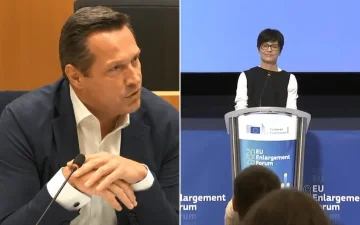
A dangerous fallacy. The context VV chooses to forget A few years ago, Dr. Nevenka Tromp, a war-crimes researcher and experienced investigator at the Hague Tribunal (ICTY), gave a lecture in which she clearly explained the context behind the creation of the Specialist Chambers: “The frequency with which President Thaçi’s name appeared in Dick Marty’s report indicated that the report’s authors—and those who supplied them with information—intended to establish a special court, and that President Thaçi could be one of the accused.
Paradoxically, the court was officially established only in 2015, after Hashim Thaçi lobbied vigorously for the Assembly to amend Kosovo’s Constitution to allow such a court to be located abroad, in The Hague. This did nothing to boost his popularity among his fellow citizens. The opposition used it in its political fight against him and his party… This discourse of failed calculations portrays Thaçi’s role in creating the court as a sign of his political weakness.” So let us be clear: the Specialist Court was not some personal project of President Thaçi.
It was the product of geopolitical blackmail. In 2015, the US government of the day exerted enormous pressure on Kosovo’s leaders and Assembly members to approve the creation of the court, in response to Dick Marty’s allegations of organ trafficking. Assistant Secretary of State Victoria Nuland made a clear threat: if Kosovo refused to establish the tribunal itself, the United Nations would impose it, and “Kosovo’s relationship with the international community would be suspended.” The choice for Thaçi and the PDK-LDK governing coalition at the time was not between saying “yes” or “no” to the special court, but between a Kosovo-led process and a court imposed by the UN under Resolution 1244.
Kosovo’s key allies in the US—from then-Vice President Joe Biden to Congressman Eliot Engel and former Senator Bob Dole—delivered clear and alarming messages. Thaçi, Mustafa, and their government chose to preserve the alliance with the US. This was not a moral or ideological position; it was a forced strategic compromise. By taking ownership of the process, Kosovo preserved at least a fragment of its sovereignty, and, more importantly, its relationship with the US.
VV’s rhetoric today erases this reality completely, claiming as if Thaçi had somehow willingly invited foreign judges to ruin his own legacy. In the same lecture in Pristina mentioned above (which, not coincidentally, VV boycotted), Dr. Tromp also offered another perspective: “Another interpretation sees Thaçi’s role in creating the Specialist Chambers as a sign of his leadership strength.
In other words, Thaçi, understanding the risk that once the court was established he himself could be accused, put Kosovo’s long-term strategic interests above his personal and professional interests.” Real straw men and false dilemmas This is VV’s specialty: simplifying complex issues in order to claim moral victories through a populist discourse of moral absolutism, propagated with Robespierrian fervor.
By portraying Thaçi’s decision as his betrayal of Kosovo, they create a “straw man” that they can easily burn. In VV’s binary world, there are only two choices: total resistance (which they claim they are heroically leading now, although in 1998–1999 they did not exactly prove themselves in battle) or total surrender to American interests. But this is a false dilemma. Refusal was never a clean or safe option for Kosovo. It would have brought about precisely the outcome the US warned of: a court imposed by the UN, entirely beyond Kosovo’s control. VV’s moral absolutism ignores the reality of compromise, portraying politics as a contest in moral purity.
This kind of discourse works well at populist rallies and in Facebook posts. It offers soothing comfort to party faithful, frames the past as a moral drama, and forever frees VV from the obligation to explain what the cost to Kosovo of refusing the court would have been. Lessons of hindsight In America there is a familiar expression: “Monday-morning quarterbacking.” It means analyzing the game after it is over, while claiming to know what should have been done differently. Kurti is a master of this in Kosovo politics.
It is easy to judge the past when you know the ending of a story or event. But in 2015, nothing was clear. Thaçi, Mustafa, and the other leaders were not facing a choice between “good and evil,” but between “bad and worse”: leaving the entire judicial process to the Russians and Chinese, or risking a fall in popularity by creating a local court, but delegating it to The Hague. No one could have known then that an American prosecutor such as Jack Smith would distort justice, shifting the focus from the false organ-trafficking allegations to an absurd indictment claiming that Thaçi was the “undisputed leader” of a “joint criminal enterprise” of the KLA, alleging as if that largely rural uprising had been a well-organized military structure. As Daniel Serwer, a former US diplomat and Balkan expert, wrote in his editorial “A Tribunal Gone Off the Rails”: “I never imagined that the Specialist Chambers would do what they have done. Kosovo’s Parliament, and I myself, believed that the main focus would be the organ-trafficking allegations. But there was a deception: one idea was sold and another was delivered.”
So VV’s “we knew it” narrative is nothing more than hindsight ‘wisdom’ displayed after the event, dressed up as prophecy. This narrative implies that Kurti possesses an omniscience no one else could have had, least of all a parliament under pressure. It is also a narrative that ignores the burden of responsible leadership when making decisions amid the fog of uncertainty and in the national interest, not with the clarity of hindsight and narrow party interests. Death by the sword In the biblical warning, then, whoever lives by the sword dies by the sword.
VV’s sword is moral absolutism—in every political decision, from the Specialist Court to dialogue with Serbia, always displayed with Robespierrian fervor. But this populist rhetoric, which delivers no results, has begun to turn against them. This black-and-white worldview serves well for partisan attacks on “traitors,” but impoverishes Kosovo’s political discourse. It also impoverishes Kosovo of alliances, and poisons relations among Albanians and between us and others. By reducing history and diplomacy to personal blame, expressed in smear language, VV betrays the very intellectual honesty it claims to defend.
The decision by Kosovo’s Assembly and Thaçi to establish the Specialist Court was not heroic, but neither was it cowardly. It was pragmatic: an imperfect choice, made under pressure and threats, within the reason and limits of a small state trying to survive the demands of its more powerful allies who liberated it and made it independent. VV’s refusal to accept this complexity is not moral clarity—it is moral laziness, if not worse. Politics, like religion, requires modesty and humility. And those who insist on brandishing the sword of moralizing justice against every opponent declared a traitor may soon discover that history—and the popular vote—also has a sharp edge.