(The New York Times) – In Kibbutz Nir Oz, time has stood still. Tricycles, dollhouses and laundry detergent piled outside burned homes bear witness to the lives that came to a halt two years ago, when a Hamas attack left 117 people dead, kidnapped or missing from this small Israeli farming community near the border with Gaza. Wind chimes ring above the collapsed swings of missing children.
Of the 384 residents at the time of Hamas’s attack on October 7, 2023, a handful have returned, but like Israel as a whole, they still find themselves gripped by a horror that the creation of the Jewish state in 1948 was intended to prevent.
“Every conversation ends with October 7,” said Ola Metzger, who recently returned with her family.
Her husband, Nir Metzger, whose father was taken hostage by Hamas and killed last year in the southern Gaza city of Khan Younis, is the secretary-general of the kibbutz. A major issue he faces is whether to demolish the burned and ruined homes or preserve them as a memorial.
“It’s a heated debate,” he said, sitting in the bright kitchen of his newly built home. “I say demolish and rebuild. I don’t want the children to pass by burned homes. It’s time to move forward.”
But how? Whether in a divided and more isolated Israel or a devastated Gaza, the future for now is shackled by new levels of distrust and hatred. Although Hamas said on Friday that it had agreed to release all the remaining Israeli hostages, alive and dead, it did not say it would accept most aspects of a plan put forward by U.S. President Donald Trump, including the demand that it disarm. Trump welcomed the statement, and Israel said it would cooperate.
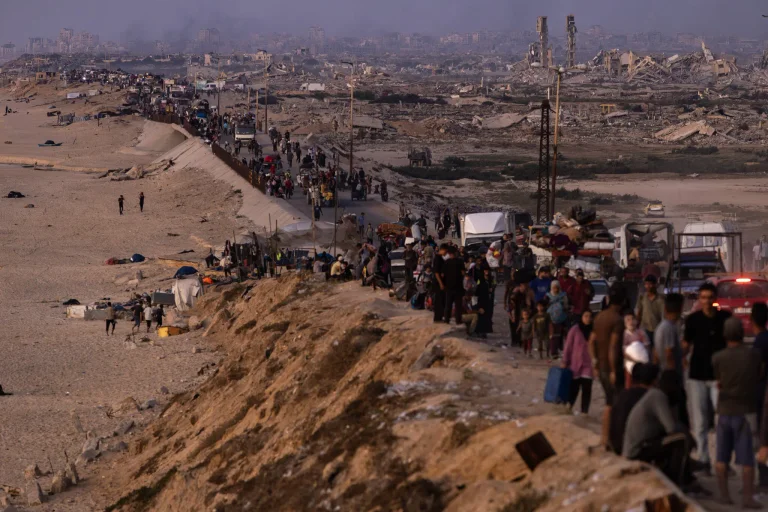
The longest war in an endless Israeli-Palestinian conflict is not over yet, and it has come to challenge Israel’s image and its understanding of itself. Its military has killed tens of thousands of Palestinians, causing destruction in every aspect of life in Gaza on such a scale that much of the world accuses it of genocide. Antisemitism is on the rise. This week’s attack on a synagogue on Yom Kippur in Manchester, England, was only the latest example.
For Palestinians, statehood, which more countries have recently recognized, remains a distant aspiration at best, and this is the intractable issue at the heart of the postwar era.
Trump, disregarding more than a century of failed Western interventions in the Middle East, has proposed a form of trusteeship over Gaza that presents prosperity “designed by well-intentioned international groups” as a “pathway” to peace.
It is an ambitious plan for a strip of land where destruction has reached apocalyptic proportions. The proposal was apparently prepared in part to allow Israeli Prime Minister Benjamin Netanyahu to declare victory over Hamas. If the hostages are released, that would surely strengthen Netanyahu’s position.
But Trump’s idea of turning Gaza into a coastal shopping hub with “preferred access fees and rates” and a marginal Palestinian role in governance seems both humiliating to the people living there and unlikely to provide them with work.
“This plan does not guarantee our rights as human beings with dignity,” Riwaa Abu Quta, a young woman from Gaza who has been living in a tent in the coastal area of Al-Mawasi for more than a year, told me in a phone interview. She has lost her home, her job and her hopes since the war began. “It gives us the feeling that displacement will be our identity.”
Displacement and the search for a homeland are, of course, inherent in the intertwined fates of Israelis and Palestinians. The Holocaust and the 1948 Nakba, or catastrophe, in which about 750,000 Palestinians were expelled during Israel’s War of Independence, compete for greater weight on the sterile scales of competing victimhood. Reviving the terrible memories of these calamities, the October 7 attack and the retaliatory war in Gaza have pushed both sides deeper into hostility.
“The killing and hostage-taking on October 7 reinforced Holocaust associations for Israel, and for many Palestinians in Gaza, the war has been a new Nakba,” said Yuval Shany, a professor of international law at the Hebrew University of Jerusalem. “So the narratives feed into an endless loop.”
In two years of the greatest defeat in the country’s 77-year history, Israelis find themselves mentally and physically exhausted—not only the 295,000 reservists who have been repeatedly called up for military service. About 83,000 Israelis emigrated in 2024, 50 percent more than the previous year.