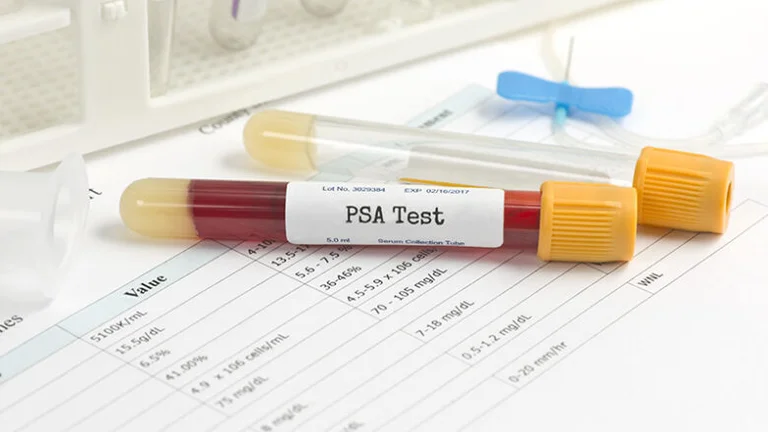
Prostate-specific antigen (PSA) is a specific protein secreted by the cells of the prostate gland and found only in men
Regular monitoring of this parameter is of great importance for the timely detection of prostate cancer, given that an elevated PSA level is not a definitive sign of this cancer.
PSA can also be elevated in some other malignant prostate conditions, as well as in infections, benign prostatic hyperplasia, and inflammation of the prostate.
Normal PSA values in men are up to 4 ng/ml. PSA values between 4 and 10 ng/ml may indicate a harmless increase in PSA in older men with a slightly enlarged prostate, inflammation of the prostate, or even the initial stage of prostate cancer.
When such values are found, monitoring PSA trends (more frequent PSA tests) is recommended, along with additional examinations recommended by a urologist to reach an accurate diagnosis, Telegrafi reports.
In the initial stage, the tumor is small, so the concentration of PSA in the blood is only slightly elevated, although it may also be slightly elevated due to non-malignant conditions. In advanced prostate cancer, the PSA value is much higher, usually above 10 ng/ml. With values this high, the probability of cancer being present is very high, and PSA is then a highly specific indicator of the disease.

Free PSA (fPSA)
PSA in plasma is partly bound to plasma proteins, and the unbound portion of PSA is called free PSA (English: free PSA, fPSA). An important aid for patients with a borderline PSA value between 4 and 10 ng/ml is determining free PSA (so-called free PSA or fPSA), which represents the portion of PSA that is not bound to plasma proteins in the blood.
The lower the percentage of fPSA, the higher the probability of cancer, and most experts recommend a mandatory biopsy when fPSA is 10 percent or less. When the fPSA value is greater than 25 percent, the risk of prostate cancer is very low.
Although PSA cannot distinguish between benign and malignant conditions, its elevated value indicates the need for additional examinations and tests, especially histopathological ones, to rule out or confirm the presence of cancer.
In patients with cancer, increased PSA concentrations can be observed up to six months before clinical and other laboratory findings, which is why PSA is widely used in the early detection of the disease.
Measuring PSA levels is also used to monitor cancer therapy. When assessing the patient's condition, in addition to absolute PSA values, whether the levels are trending upward or downward is analyzed.
When should you have a PSA test?
To prevent the development of prostate cancer, PSA marker screening is recommended for every man over 50 and for men over 45 in families with hereditary disease, as well as an examination by a urologist.
– Early screening for this disease is crucial to prevent the appearance of metastases. Every man over 50 should have a PSA marker test from his blood and visit a urologist once a year, even if he has no symptoms, as should every man over 45 who has a family member with prostate cancer.